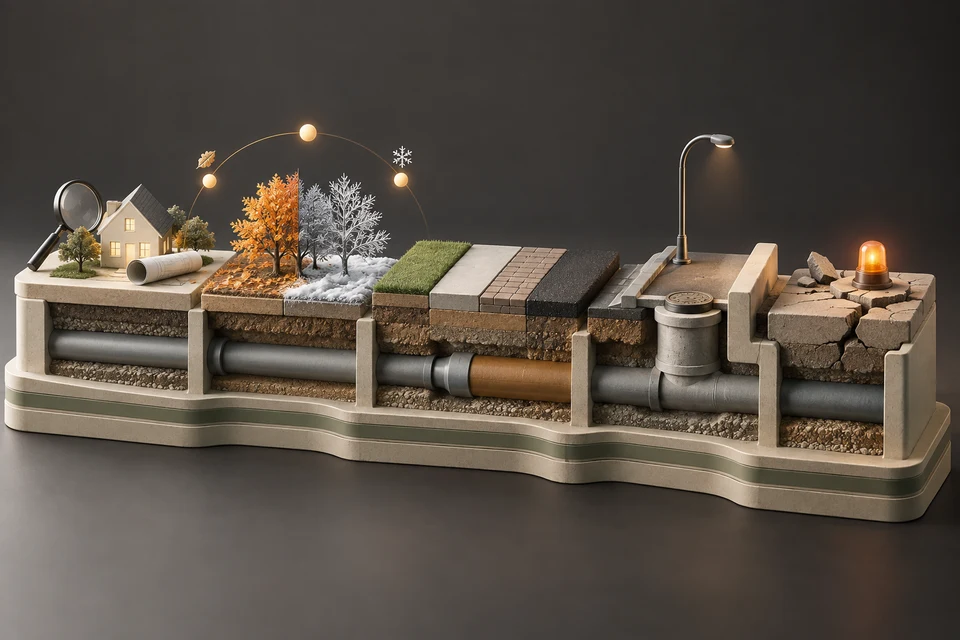
The Replacement Timeline Planner lays out the six steps of a sewer replacement, from camera and quotes to restoration, with a planning range for each based on your method, season, surface, City-side work and urgency. It shows a start-to-finish planning range, the step list, and a winter note when winter is chosen. Everything is labelled as planning ranges, not a schedule.
- Five inputs: method, City-side work, season, surface and urgency.
- Six steps: camera and quotes, permits, utility locates, work on site, inspection, backfill and restoration.
- Emergency shortens camera and quotes to 1 to 2 days; winter adds 1 to 2 days of frost time on site.
- City-side work lengthens the permit step and widens the start-to-finish range.
- The result is a planning range to discuss with contractors, not a booking or a commitment by anyone.
Replacement Timeline Planner
01 /What does the Replacement Timeline Planner do?
The planner answers the question most owners ask right after “what will it cost”: how long will this take, from today until the yard is back? It breaks a Calgary sewer replacement into the six steps every job goes through, gives each a planning range adjusted to your answers, and shows a start-to-finish planning range for the whole job. It is built on the same sequence as the replacement process step by step.
It does not schedule anything, contact anyone or check live availability. It will not know your contractor's backlog, the City's current permit volumes or next week's weather. It gives you realistic expectations and a list of the steps that usually decide the calendar, so you can plan around them and ask better questions.
02 /What do you enter?
Five choices, each a single selection. None asks for your address or contact details.
| Input | Options | What it changes |
|---|---|---|
| Method | Open cut / lining / bursting / spot repair | The days of work on site |
| City-side work involved | No / yes (boulevard or road) | The permit step reads longer, and the start-to-finish range widens |
| Season | Summer / spring or fall / winter | Winter adds frost time on site (1 day to the short end, 2 to the long end), a week to the top of the total, and the winter note |
| Surface | Lawn / landscaping / driveway-concrete | The backfill and restoration step |
| Urgency | Planned / emergency (backup now) | Emergency shortens camera and quotes to 1–2 days |
If you are not sure which method applies, run the planner once for each method you have been quoted. The difference in on-site days is usually smaller than owners expect; the permit, locate and restoration steps are the same or similar for every method.
03 /What steps and planning ranges does it use?
The planner uses six steps, in the order they happen, with these planning ranges.
| Step | Planning range | How your answers change it |
|---|---|---|
| Camera and quotes | 1–2 weeks | Emergency: 1–2 days |
| Permits | Days to a few weeks — confirm with the City | Longer when City-side work is involved |
| Utility locates | Allow several business days | Emergency: emergency locates exist — ask your contractor |
| Work on site | Open cut 1–3 days, lining 1 day, bursting 1–2 days, spot repair 1 day | Winter adds 1–2 days for frost |
| Inspection | Book with the City or inspector | Depends on booking windows |
| Backfill and restoration | Lawn: topsoil and seed now, full recovery next season. Landscaping: days to weeks, depending on the landscaping. Driveway or concrete: a few days to weeks for pour and cure | In winter, the winter note adds that restoration is often temporary until spring |
Where these ranges come from in practice: Utility Safety Partners asks for at least three full working days of notice for a routine locate and has warned that busy periods stretch responses to between 5 and 10 business days. The City says next-day plumbing inspection requests must be made by 2 p.m. The City's excavation permit page lists processing of up to two business days for standard right-of-way applications and up to 10 business days where recently laid pavement is affected, and street use permits carry minimum reviews of 5 to 15 business days. Those are the reasons the planner keeps permits and locates as ranges rather than fixed numbers.
04 /What does the result show?
The result has three parts.
- A start-to-finish planning range at the top. For a planned job it starts at 2–5 weeks; City-side work widens it to 3–8 weeks, and winter adds a week to the top end. For an emergency it reads “days to about 2 weeks”.
- The step list, with each step's planning range adjusted for your answers.
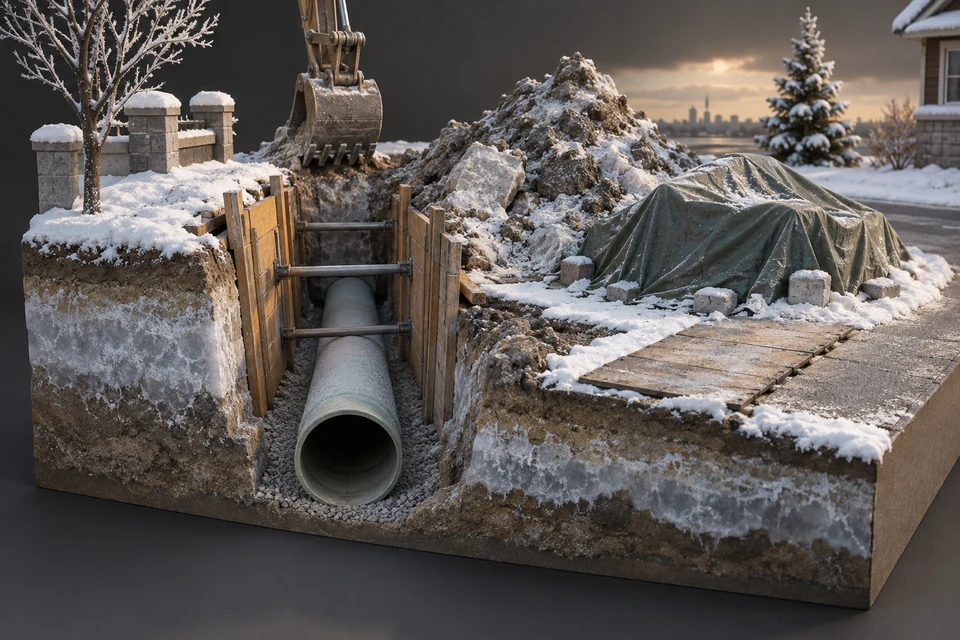
- A winter note when winter is chosen: frozen ground adds time and cost, and restoration is often temporary until spring.
The whole result closes with the line “Planning ranges, not a schedule. Permit and locate timing is set by the City and utilities.” The total is useful for booking time off, telling neighbours, and deciding whether a job can finish before freeze-up; it is not a date anyone has promised.
05 /How should you read the result for your job?
Read it from the top, because the early steps usually decide the total. For a planned job, camera and quotes plus permits typically take more calendar time than the digging. For an emergency, camera and quotes shrink to days, but the locate rules and the inspection still apply.
| Situation | What dominates | What to do early |
|---|---|---|
| Planned open cut, summer, lawn | Quotes, permit and the locate window | Get footage and scope first; book the locate as soon as the date is firm |
| Planned lining, any season | Quotes and permit; the site day is short | Confirm with the City whether the lining job needs a permit |
| Open cut under a driveway | Concrete pour and cure after settlement | Agree the concrete timing and who does it |
| Any method with City-side work | City permits and coordination | Call 311 early with the footage |
| Emergency in winter | Frost, then temporary restoration | Put the spring return visit in writing |
Detail on the slow steps: Calgary plumbing permits, utility locates, winter replacement and backfill and restoration.
06 /What are the planner's limits?
- It does not know your ground. Cobble, groundwater, an unmarked line or a deeper-than-expected lateral can add days on site. The soils and depth page explains the Calgary conditions behind that.
- It does not know the City's queue. Permit and inspection timing are ranges to confirm with the City.
- It does not know your contractor's calendar. In peak season, the wait to start can exceed the job itself.
- It does not model settlement in detail. Concrete over a trench may wait for settlement; lawns recover over a season.
- It does not replace a written schedule. Ask your contractor for start and completion dates in the contract.
Pair the planner with the Permit & Locate Checklist, which tracks the paperwork steps that most often cause delays. When the plan looks right, request quotes and ask each contractor how their schedule compares with the planner's ranges.
FAQQuestions people ask
How long does a sewer line replacement take in Calgary?
The crew is usually on site for one to three days for open cut, about a day for lining or a spot repair, and one to two days for bursting. From first camera to finished restoration, a planned job typically takes a few weeks.
Why does the planner show a range instead of a date?
Because permits, locates, inspections and weather vary. The planner labels everything as planning ranges, not a schedule; your contractor sets the dates.
Does the planner book locates or permits?
No. It is a planning aid only. Your contractor requests locates through Utility Safety Partners and applies for permits.
What does choosing winter change?
It adds frost time to the work on site, a week to the top of the total, and a note that frozen ground adds time and cost and that restoration is often temporary until spring.
What does City-side work change?
The permit step reads longer and the start-to-finish range widens, because work in the boulevard or road involves separate City permits and coordination.
NETWORKGo deeper across the HAUSE Sewer network
How to compare sewer quotes line by line
How to compare sewer quotes: a line-by-line worksheet to normalise scope, spot missing items, convert to per-metre cost and choose between three contractor quotes.
PipeCleaning.caPipe cleaning cost in Canada, method by method
Pipe cleaning cost in Canada for 2026: planning ranges for snaking, hydro jetting, descaling, camera inspection and stacks, and what moves a quote.
SewerInspector.caSewer camera inspection cost: 2026 planning ranges for Canada
Sewer inspection cost in Canada for 2026: planning ranges for a camera scope, locating, toilet access, clean-and-scope and multi-unit work, and price drivers.