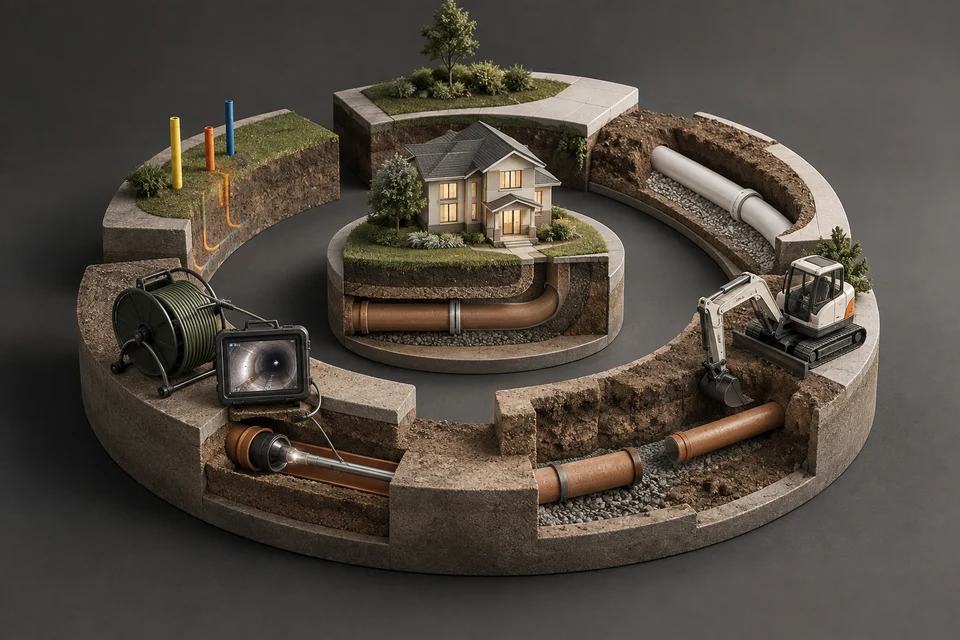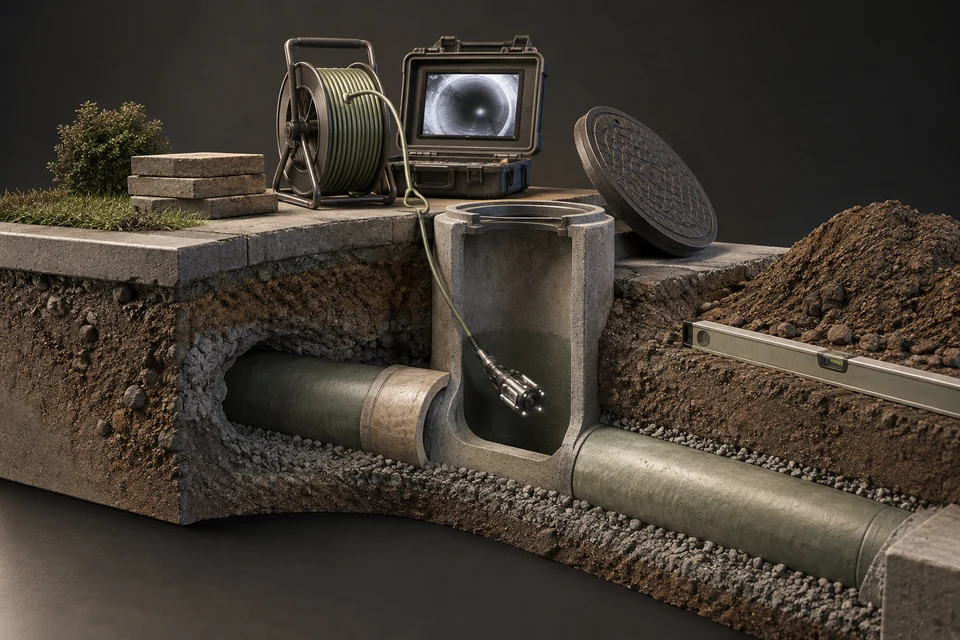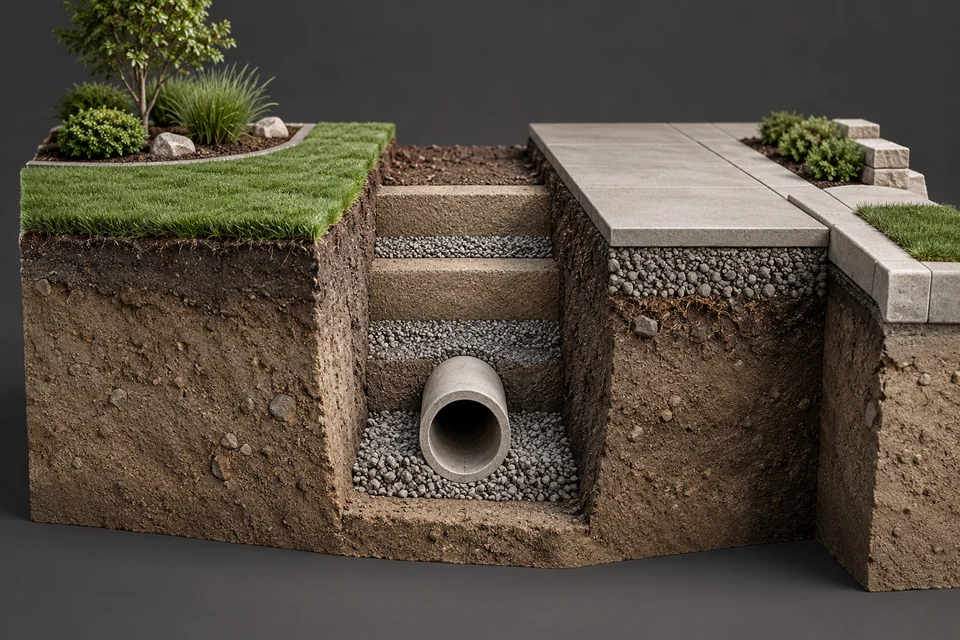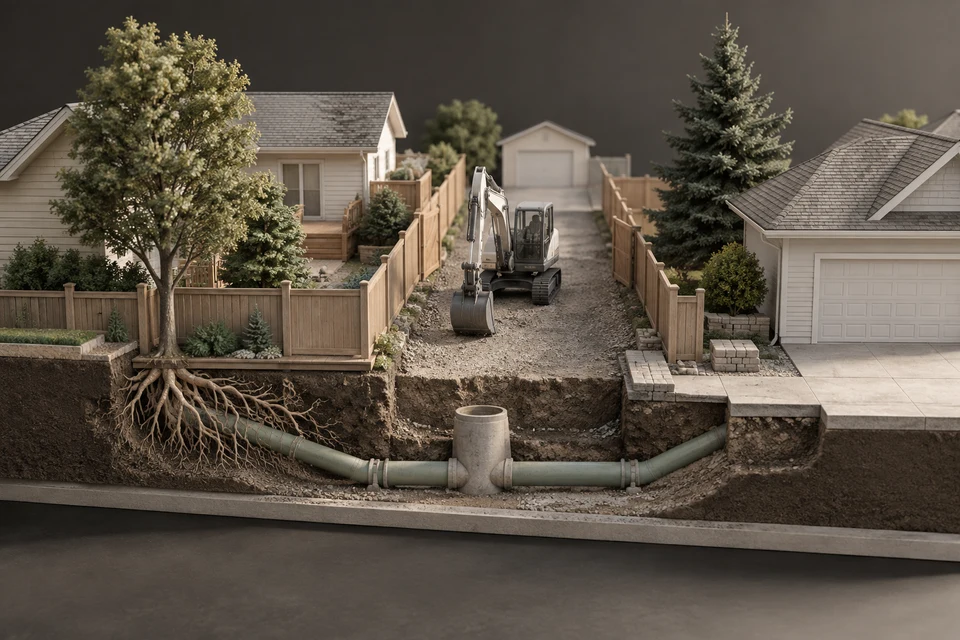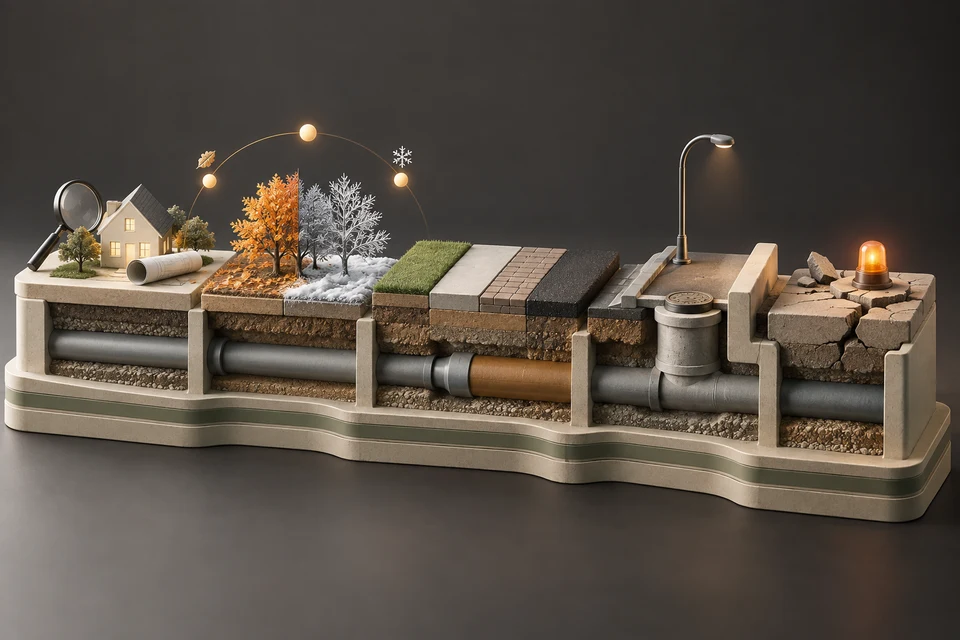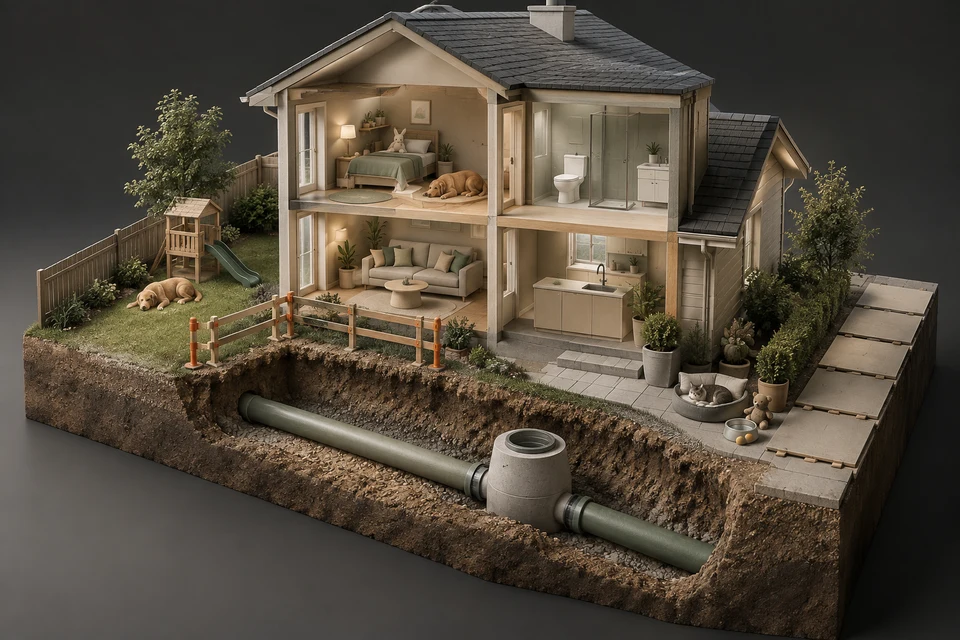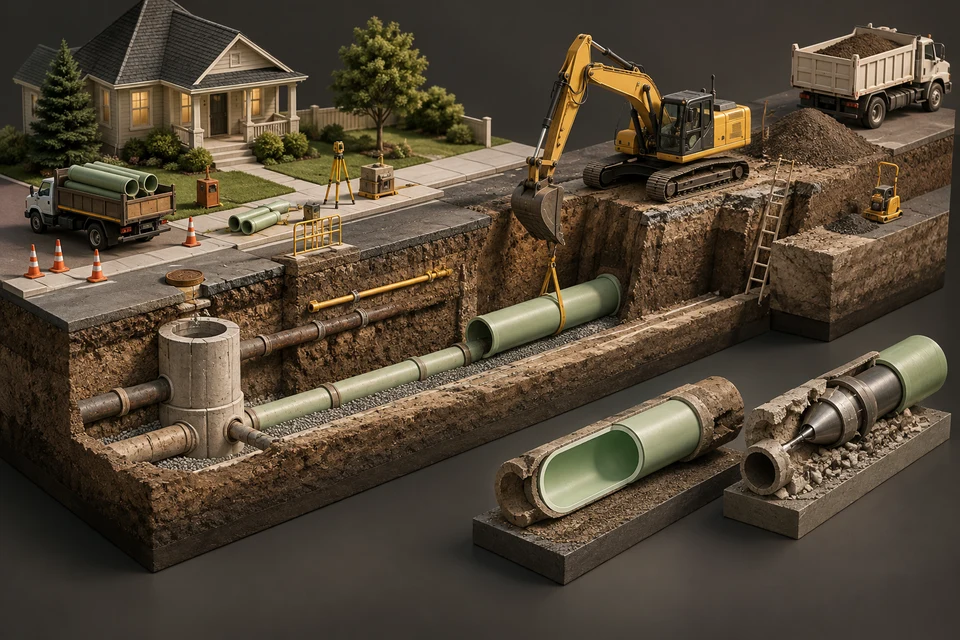
A typical open-cut lateral replacement on a Calgary house lot takes about three working days. Day one is set-up, surface protection, utility exposure and excavation. Day two is removing the old pipe, shaping bedding, laying the new pipe to grade and making connections. Day three is inspection, camera, backfill in compacted lifts and cleanup. Lining usually takes one day on site and bursting one to two.
- Most of what happens on day one is protection and exposure, not digging the lateral itself.
- The house cannot drain from the moment the old pipe is cut until the new one is connected; ask for that window in advance.
- Inspection has to happen while the pipe, joints and bedding are visible, so backfill waits for it.
- Grade is set and checked as the pipe goes in; a belly found after backfill means digging again.
- Restoration beyond rough grading usually comes later, after the trench has had time to settle.
01 /What should be done before the crew arrives?
The day before a dig should be quiet on site and busy on paper. By then, the permit is issued, the locate tickets are complete and the marks are visible, the private locate has put the lateral route and depths on the ground, and materials are ordered. Your jobs are access and household planning.
- Move vehicles out of the driveway and off the street frontage if the contractor asks.
- Clear the path the machine will take: planters, furniture, hoses, loose pavers.
- Open gates and lift fence panels if agreed, and secure pets indoors.
- Photograph the yard, driveway, walk, foundation and any existing cracks from several angles.
- Tell neighbours what is happening and for how long; see neighbours and access.
- Plan water use: laundry and dishwasher done the evening before, and a plan for the hours when nothing can drain. Living at home during the job has a fuller household plan.
02 /Day one: set-up, exposure and excavation
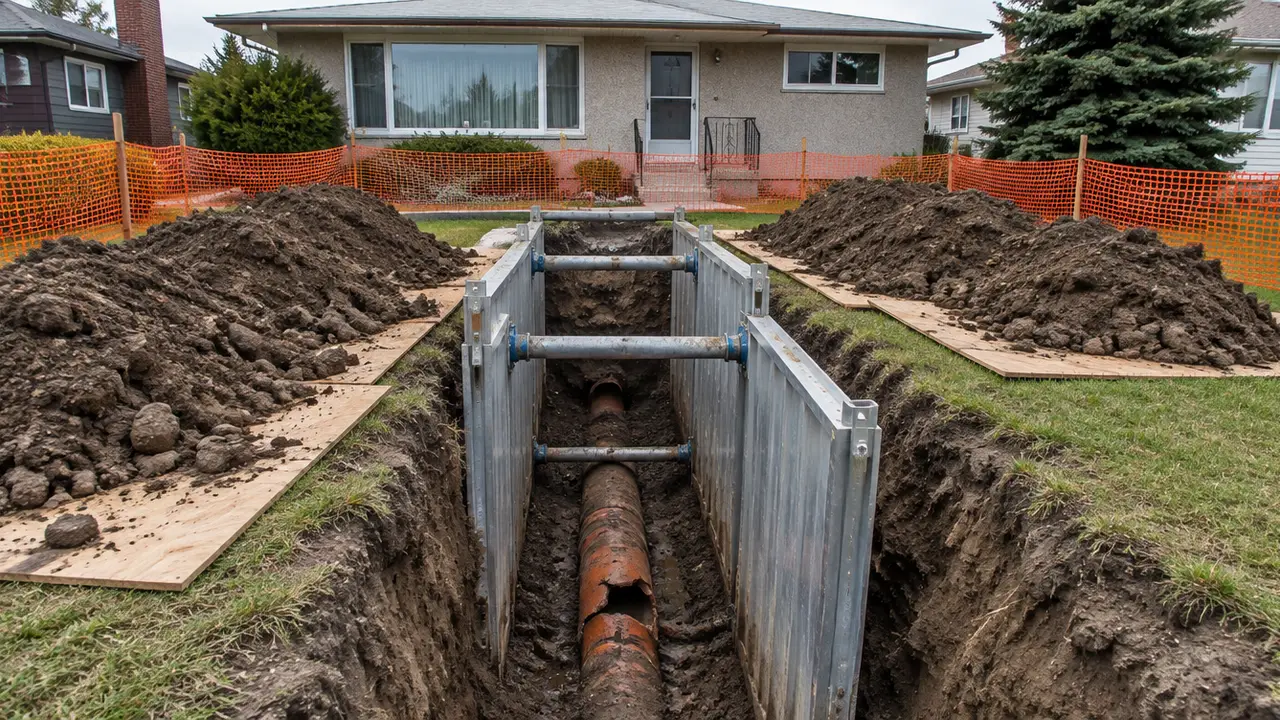
Day one is about making the site safe and finding everything before the lateral is reached. On a straightforward lot the trench is usually opened by the end of the day; on a crowded one, exposure work can take most of it.
| Time of day | What the crew does | What you notice |
|---|---|---|
| Early morning | Walk the site, compare locate marks to the ground, set fencing or barricades, lay ground mats or plywood for the machine | Trucks arriving; questions about gates and parking |
| Morning | Cut and roll sod to reuse if planned; lift pavers; hydrovac or hand-dig to expose gas and other marked lines | A hydrovac truck; neat holes over the marks |
| Midday | Excavate from one end, often the foundation or the property-line end; set the trench box or cut back walls as depth passes 1.5 m | Spoil pile growing on tarps, back from the edge |
| Afternoon | Expose the old pipe along the route; pump water if it collects; check depths against the locate readings | The old clay, cast iron or other pipe visible in the trench |
| End of day | Cover or fence the trench, secure the site, confirm the next day's drain shutdown | A fenced or covered trench overnight |
03 /Day two: out with the old, in with the new
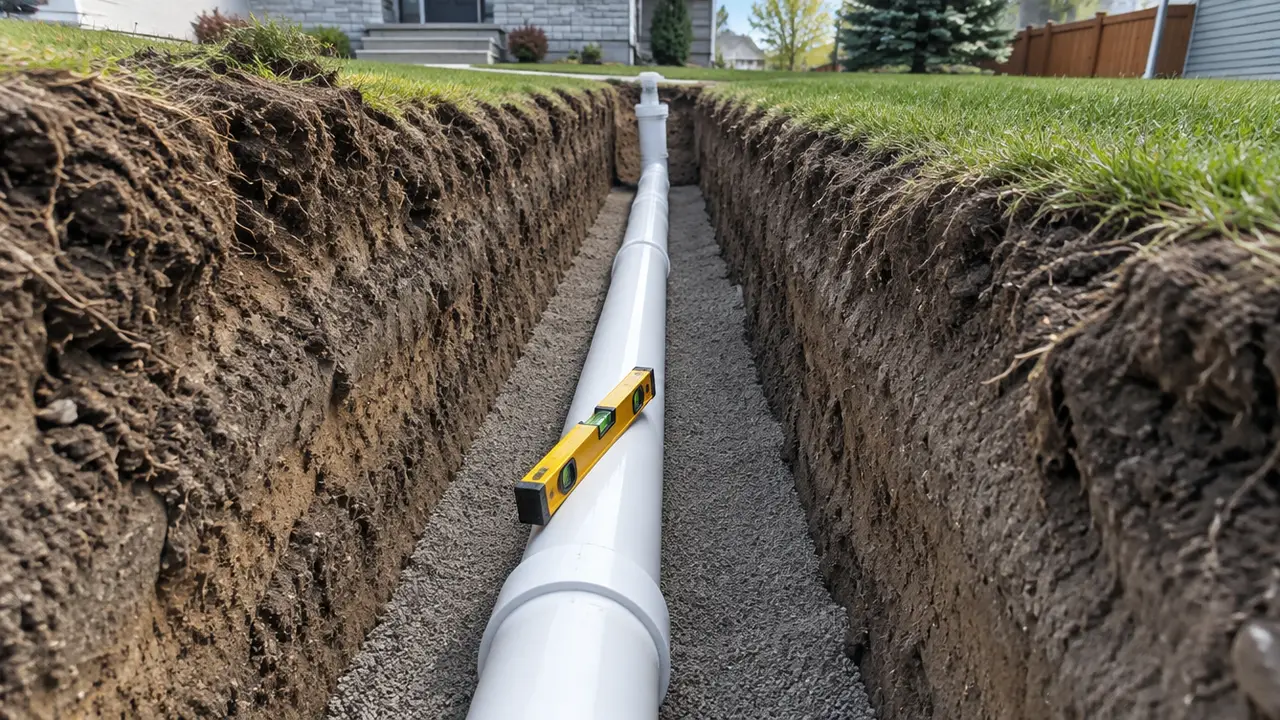
Day two is when the house loses its drain for several hours. The crew cuts the old pipe near the house and at the property-line end, removes the section between, and prepares the trench bottom for the new pipe.
- Cut and remove the old pipe
Clay and cast iron come out in pieces; the old bedding is cleaned out and any soft spots dug out and replaced.
- Shape the bedding
Granular bedding is placed and shaped so the pipe is supported along its full length, not on its bells or on rocks.
- Set the grade
A laser or level sets a continuous fall from the house toward the street. Each length is checked as it goes in.
- Lay and join the pipe
New sewer pipe, commonly PVC in residential laterals, is laid bell-uphill and joined with gaskets or couplings as specified.
- Connect both ends
Transition couplings join the new pipe to the building drain at the foundation and to the City section at the property line.
- Add cleanouts
Any cleanout risers in the scope are installed and capped.
- Camera the new line
A run through the new pipe confirms no dips, no gaps and clean connections.
By early afternoon the crew usually knows whether the line is ready to inspect. Because the City says next-day inspection requests must be made by 2 p.m., that timing often decides whether inspection is day three or later. Inspections on a Calgary sewer replacement explains what the inspector looks at.
04 /Day three: inspection, backfill and cleanup
Day three starts with waiting for the inspector, then moves quickly once the work passes. The trench is filled in layers rather than all at once, because loose backfill settles for months.
- The inspector checks the pipe, joints, bedding, grade and connections, and any test required.
- The crew places initial backfill around and just over the pipe by hand or carefully with the bucket, so the pipe is not knocked off grade.
- Backfill goes in lifts, each compacted with a plate compactor or rammer before the next. Deep Calgary trenches take many lifts.
- The trench box or shoring comes out as the fill rises; sloped walls are filled back.
- The surface is rough-graded slightly high to allow for settlement.
- Excess spoil and old pipe are hauled away; mats come up; the site is swept and raked.
- You receive the after-video and, ideally, the as-built measurements the same day.
Restoration of lawn, landscaping and concrete usually comes after a settlement period, which can be weeks for concrete and the following season for a lawn to recover fully. The details are in backfill and restoration.
05 /How do lining and bursting days compare?
Trenchless jobs compress the schedule because far less ground is opened, but the house is still without a drain for part of the day.
| Method | Days on site | What fills the day |
|---|---|---|
| Open cut | 1–3 days, plus frost time in winter | Exposure, excavation, laying, inspection, backfill |
| Lining (CIPP) | About 1 day | Cleaning the host pipe, camera, inverting and curing the liner, reinstating connections, final camera |
| Pipe bursting | 1–2 days | Digging launch and receiving pits, pulling the cable, bursting and pulling in new pipe, connecting at the pits |
| Spot repair | About 1 day | One pit, cut out the bad section, couplings, inspection, backfill |
The same ranges drive the Replacement Timeline Planner. What happens on a trenchless day, including curing and reinstating connections, is covered in trenchless replacement in Calgary.
06 /What should you ask the crew lead each morning?
A two-minute conversation at start-up keeps the household and the job in step. The crew lead usually knows the plan for the day by the time the machine is warming up.
- When will the drain be out of service today, and for how long?
- Will anything block the driveway, garage or front door, and when?
- Has anything unexpected turned up in the ground, and does it change the scope or schedule?
- Is the inspection booked, and for which day?
- What will be left open, fenced or covered tonight?
Write the answers down with the date. They become part of the job record and make it easy to raise a concern early, while the crew can still act on it.
07 /What can slow a day down?
Most delays on a sewer job are discoveries in the ground rather than slow work. Knowing the usual ones helps you read the crew's morning conversation.
| Surprise | Effect | What usually happens |
|---|---|---|
| An unmarked private line | Work stops near it | Identify, protect or reroute; update the sketch |
| Cobble or boulders | Slower digging; a wider trench | Heavier bucket work or a breaker |
| Groundwater or a wet silt layer | Walls weep or run; bottom softens | Pumping, extra bedding, sometimes a wider box |
| The lateral deeper or offset from the locate | More excavation | Chase the pipe; re-check depth readings |
| The City section in poor shape at the joint | Connection question | Pause the connection; call 311 through the permit holder |
| Inspection slot the next afternoon | Trench open another night | Cover and secure; adjust household water plan |
Before you book, run your method, season and surface through the Replacement Timeline Planner, then request quotes that state how many days the crew expects to be on site.
FAQQuestions people ask
How long will I be without a toilet during a sewer replacement?
On an open-cut job, typically several hours on the day the old pipe is cut and the new one connected, and sometimes a second shorter window. Ask the crew for the exact window each day.
Do I need to be home during the work?
Not all day, but be reachable, and be there at start-up on day one and when the inspection and after-video happen.
Will the crew dig inside my basement?
Only if the scope includes the building drain under the slab or the connection is made from inside. That involves cutting concrete and should be in the written scope.
Why is the trench left open overnight?
Usually because inspection has to happen before backfill. It should be fenced or covered and secured overnight.
What happens to the old pipe?
It is removed and hauled away with excess soil in an open-cut job. In bursting, the old pipe is broken into the surrounding soil; in lining, it stays as the host pipe.
NETWORKGo deeper across the HAUSE Sewer network
Sewer scope on a new build: what goes wrong in brand-new sewer lines
Is a sewer line inspection necessary for new construction? What goes wrong in new laterals, when to scope before warranty dates, and what to ask the builder.
SewerJetting.caIs hydro jetting safe for PVC and ABS drain pipe?
Can hydro jetting damage PVC or ABS pipe? What plastic lines tolerate, where they are weak (joints, fittings, bellies, heat) and how to jet them safely.
SewerRoots.caHow serious are roots in a sewer line, and what happens if you leave them?
How serious are roots in a sewer line? Whether roots are normal, how intrusion moves from fine roots to backups, sags and breaks, and how urgent yours is.