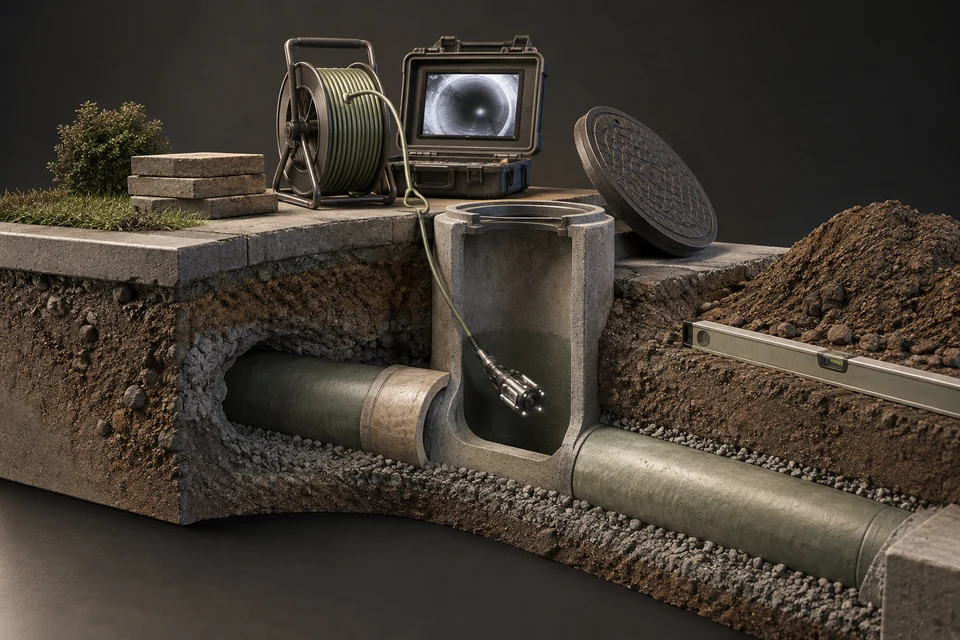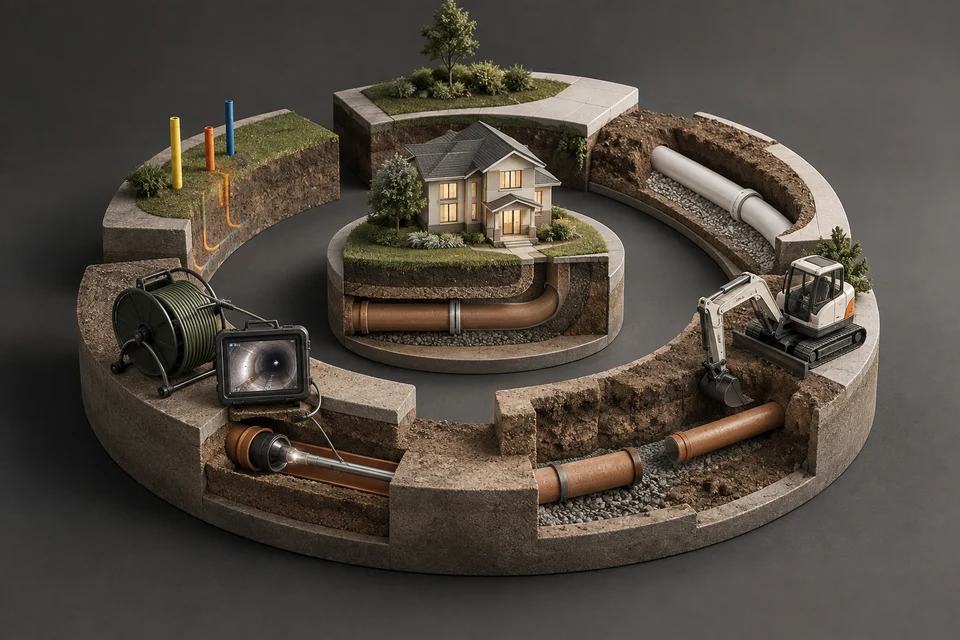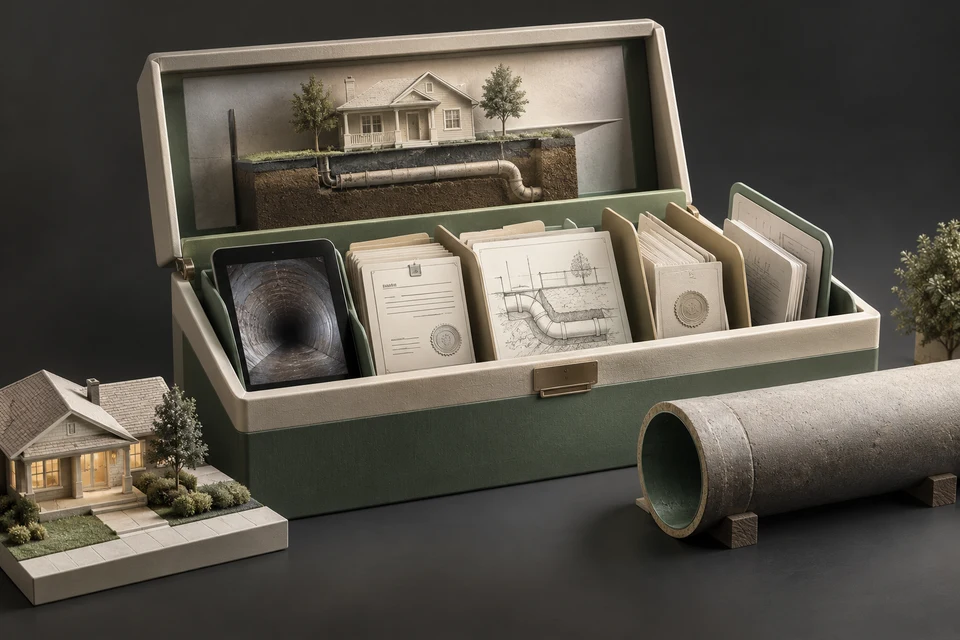
After a Calgary sewer replacement, keep a single file with the before and after camera videos and logs, the permit number and inspection result, the locate ticket, an as-built sketch with distances, depths and materials, the warranty terms, invoices, the WCB clearance and any 311 correspondence. That file answers the questions a buyer's inspector, an insurer or the next contractor will ask, and it outlasts everyone's memory of the job.
- The after-video with its footage counter is the single most useful record; ask for the full file, not clips.
- An as-built sketch with measured distances and depths turns the next locate from a search into a check.
- A permit number the City can look up carries more weight than an invoice alone.
- Ask whether the warranty transfers to a future owner, and get the answer in writing.
- For buying and selling decisions, the records support the conversation with your REALTOR® and lawyer; they do not replace it.
01 /Why keep records of a sewer replacement?
Because the work disappears the day it is finished. Once the trench is backfilled and the lawn grows in, the only evidence that a new pipe runs under the yard, what it is made of, how deep it is and who inspected it is on paper and video. The people who will need that evidence are rarely you, today: a buyer's sewer inspector years from now, an insurer after a backup, a contractor chasing a new problem, or the City if a question arises at the property line.
Good records also save money. A contractor who can see the as-built sketch and the after-video can often diagnose a later problem with a short camera run instead of a new investigation. A buyer's inspector who can compare fresh footage with yours can tell quickly whether anything has changed.
02 /What belongs in the sewer file?
| Record | Where it comes from | Why it matters later |
|---|---|---|
| Before-video and log | The inspection that led to the job | Shows why the work was done and what was replaced |
| Written scope and contract | Your contractor | Defines what was and was not included |
| Permit number and inspection result | The permit holder and the City's permit records | Shows the work was permitted and passed |
| Locate ticket number | The contractor's Utility Safety Partners request | Shows the dig followed the locate process |
| As-built sketch | The contractor, ideally with your own measurements | Where the new pipe runs, its depths, cleanouts and joints |
| After-video and log | The contractor's camera operator | The baseline condition of the new line |
| Photos of the open trench and joints | You or the crew, before backfill | Proof of bedding, couplings and the property-line connection |
| Pipe and liner details | Contract, invoice or product labels | Material, size and, for liners, the system and cure method |
| Warranty terms | The contractor, in writing | What is covered, for how long, and whether it transfers |
| Invoices and payment records | The contractor | Cost, dates, and proof of payment |
| WCB clearance and insurance certificate | WCB-Alberta and the contractor | Shows coverage was in place during the work |
| 311 service request numbers and City responses | The City | Any City-side assessment or work |
| Restoration completion photos | You | The finished surfaces and any settlement follow-up |
03 /What makes a good as-built sketch?
A good as-built sketch lets someone who has never seen your yard find the pipe with a tape measure. It does not need to be drawn to scale by a draftsperson; it needs measurements from things that will still be there in twenty years.
- Distances from the foundation wall to each cleanout, bend and joint of interest, and to the property line.
- Depth to the top of the pipe at the foundation, mid-yard and at the property line.
- The pipe material and size, and the coupling types at each end.
- Offsets from fixed features: house corners, the driveway edge, a fence line.
- Where any tracer wire or marker tape was installed.
- Which surfaces cover the pipe now, after restoration.
- The date, the address, the contractor's name and the permit number.
04 /How do the records help when you sell?
They let a buyer see what was done instead of taking it on trust. Many buyers of older Calgary homes commission a sewer camera inspection before firming up, and a buyer's inspector will scope the line regardless of what you provide. Your file gives them context: the before-video shows what was wrong, the after-video shows the new line as it was on day one, and the permit and inspection show it was done under the City's process.
What you are required to disclose, and how records are shared during a sale, are questions for your REALTOR® and your lawyer; this page is not real estate or legal advice. CalgarySewerReplacement.com covers buying and selling older Calgary homes with sewer questions in more depth.
05 /How do the records help with insurance and future repairs?
After a backup, an insurer or adjuster may ask about the condition and history of the line. A dated after-video and the replacement invoice show the private line was renewed and when, which helps separate a City-side or overland event from a private-line failure. Policies and coverage vary widely; your broker can say what your policy needs.
For future repairs, the file shortens every step. The next locate becomes a check of your sketch. The next camera run can be compared frame by frame with the after-video. And if a problem appears at the property line, your photo of the joint and any 311 service request numbers go straight to the City with the new footage.
- Label everything
Address, date and content in each file name, for example the address, the date and “after-video”.
- Keep two copies
One digital copy in cloud storage and one on a drive or in paper form with the house documents.
- Keep the originals
Full video files, not compressed clips sent by text message.
- Add to it
Later cleanings, camera runs and any settlement repairs go in the same file.
- Pass it on
At sale, share it as your REALTOR® and lawyer advise.
06 /What records should you ask for if the work was done years ago?
If you bought a home where the sewer was replaced before your time, rebuild the file as far as you can. Some of it can still be recovered, and a fresh camera run fills most of the gaps.
- Ask the seller's side for any invoices, videos or warranty documents passed on at the sale.
- Search the permit history through the City's permit records; a property's permit history can show whether plumbing work was permitted and when. Property research requests go through 311.
- Contact the original contractor if the name is known; some keep job videos and sketches.
- Book a new camera run with a sonde trace to create a current baseline video and a sketch of where the line runs and how deep it is.
- Look up the City-side record for your address to see what the City section is made of, remembering that it covers only the City-owned portion.
A rebuilt file is not as strong as one collected at the time, but a recent video and sketch answer most of the practical questions a buyer or contractor will ask.
07 /When should you collect each record?
Collect as you go, because some records can only be made at one moment. The trench photos exist only before backfill; the after-video is easiest to get while the crew is on site; the permit result is easiest to request right after inspection. The Permit & Locate Checklist builds these into the job: a before-video, a booked inspection, an after-video and warranty in writing, the restoration scope in writing, and finally invoices and permits filed for the house records. For how each fits the job sequence, see the replacement process step by step and inspections before backfill.
Nobody remembers the depth of a sewer line twenty years later. A sketch does.
FAQQuestions people ask
What paperwork should I get after a sewer line replacement?
The before and after videos with logs, permit number and inspection result, as-built sketch with distances and depths, material details, written warranty, invoices, WCB clearance and any City correspondence.
Does a sewer line warranty transfer to a new owner?
It depends on the contractor's terms. Ask before signing and get the answer in writing, because it is one of the first questions a buyer asks.
How do I prove my sewer line was replaced?
A permit number and passed inspection, the after-video and the invoice together are strong evidence. Photos of the open trench help further.
Will the City's online records show my new pipe?
The City's public service line records cover only the City-owned section, so private-side work is not shown there. Your own records show it.
Should I give my records to a buyer's sewer inspector?
Many sellers do, as context for the inspector's own camera run. Ask your REALTOR® and lawyer how records should be shared in your sale.
NETWORKGo deeper across the HAUSE Sewer network
Should you scope the sewer before buying a house?
When a sewer scope before buying a house is worth it, which homes need one most, how to fit it inside a condition period, and what to do with the result.
SewerCleaners.caHow to hire a sewer cleaner: the checklist, the questions and the paperwork
How to hire a sewer cleaner in Canada: questions to ask, insurance and WCB coverage in Alberta, a written scope template, red flags, and how to compare quotes.
SewerQuotes.comSewer camera inspection cost, and what the fee should include
Sewer camera inspection cost in Canada for 2026: standalone, pre-purchase and add-on scope prices in CAD, what a proper report includes and when the fee is wasted.