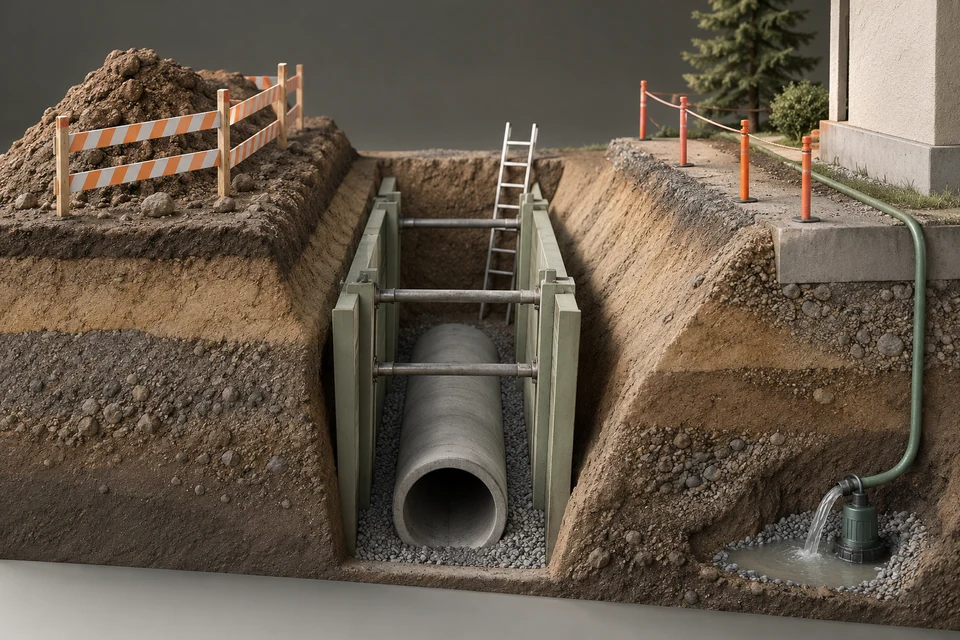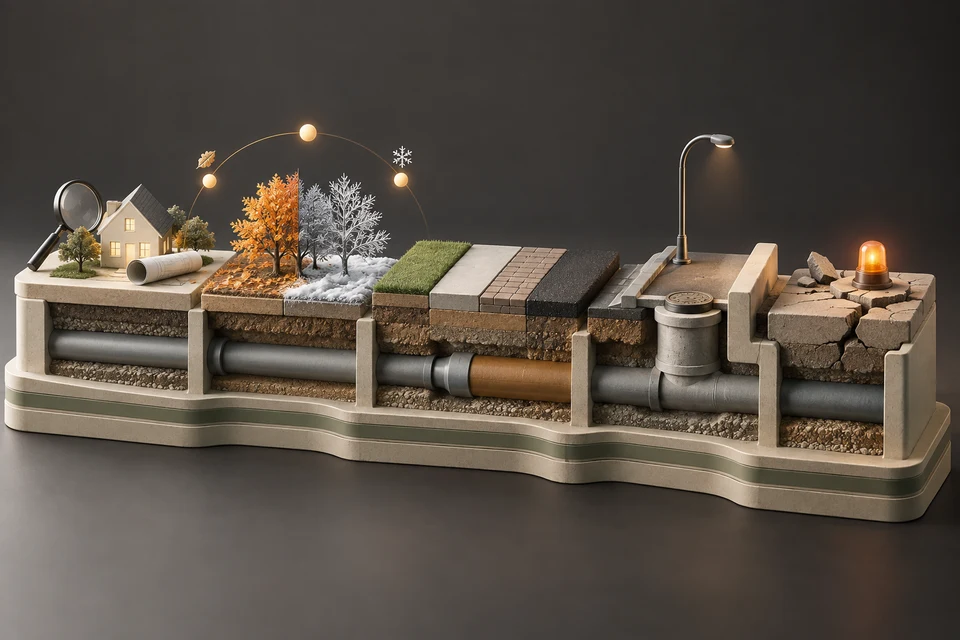
A Calgary sewer trench usually runs through topsoil, clay-rich glacial till and, in many places, lake silts or quartzite gravel and cobble, with sandstone bedrock close below in some areas. Because the drain leaves a basement house below the basement floor, laterals commonly sit around 2 to 3 m deep or more and fall toward the main. That depth brings Alberta's trench-protection rules into play, and the soil decides how the walls are protected.
- The Alberta Geological Survey describes Calgary's surface materials as till, thick lake sediments of silt and very fine sand, and quartzite gravel or hard sandstone under a thin cover in many places.
- Depth follows the basement: the lateral starts below the basement floor and keeps falling, so most of a basement house's lateral is deeper than 1.5 m.
- Previously dug ground, wet silt and gravel below the water table are the least stable soils in Alberta's trench classes.
- The City's records show clay tile dominating City-side installs in the 1960s and 1970s and PVC from the 1980s; your private side can differ.
- Frost reaches deepest under cleared driveways and walks, which is where shallow sections of lateral are most at risk.
01 /What is under a Calgary yard?
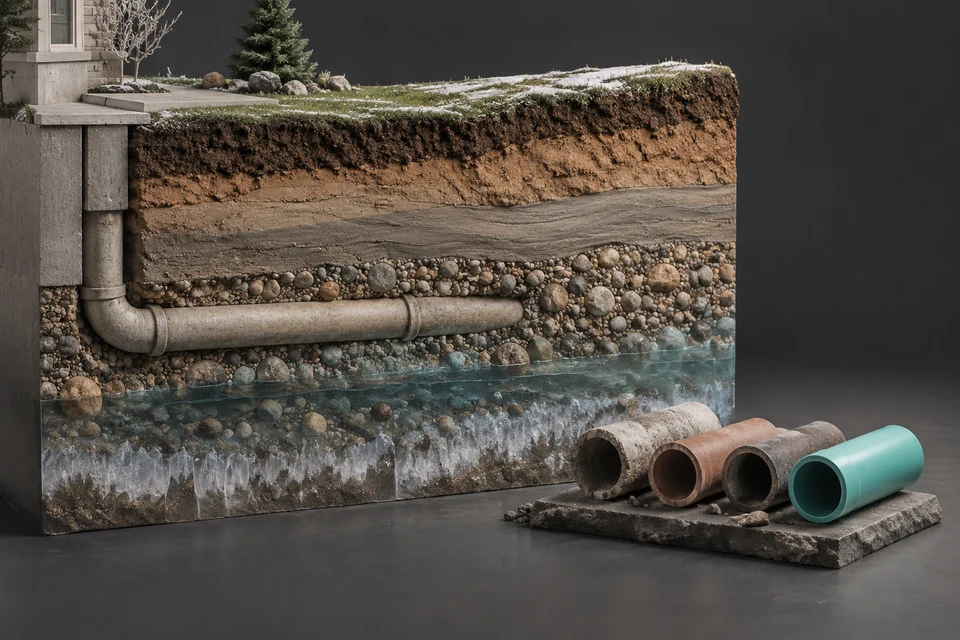
Under the topsoil, most Calgary lots sit on material left by glaciers and the lakes that formed as they melted. The Alberta Geological Survey's bulletin on the surficial geology of the Calgary urban area, by S. Moran, identifies three main surface materials: till, thick lake sediment made up largely of silt and very fine sand, and quartzite gravel or very hard sandstone bedrock beneath a thin cover of till or lake sediment. The bulletin notes that this last combination creates difficult digging conditions that can significantly increase construction costs.
Below all of it is sandstone and mudstone bedrock, the Paskapoo Formation, the stone of Calgary's older sandstone buildings. On some lots it lies well below any sewer trench; on others, especially near valley edges and slopes, it can be close enough to meet. A sewer crew in Calgary may dig through all of these in a single trench, which is why contractors ask what the neighbours found when they dug.
02 /How does each Calgary soil behave in a sewer trench?
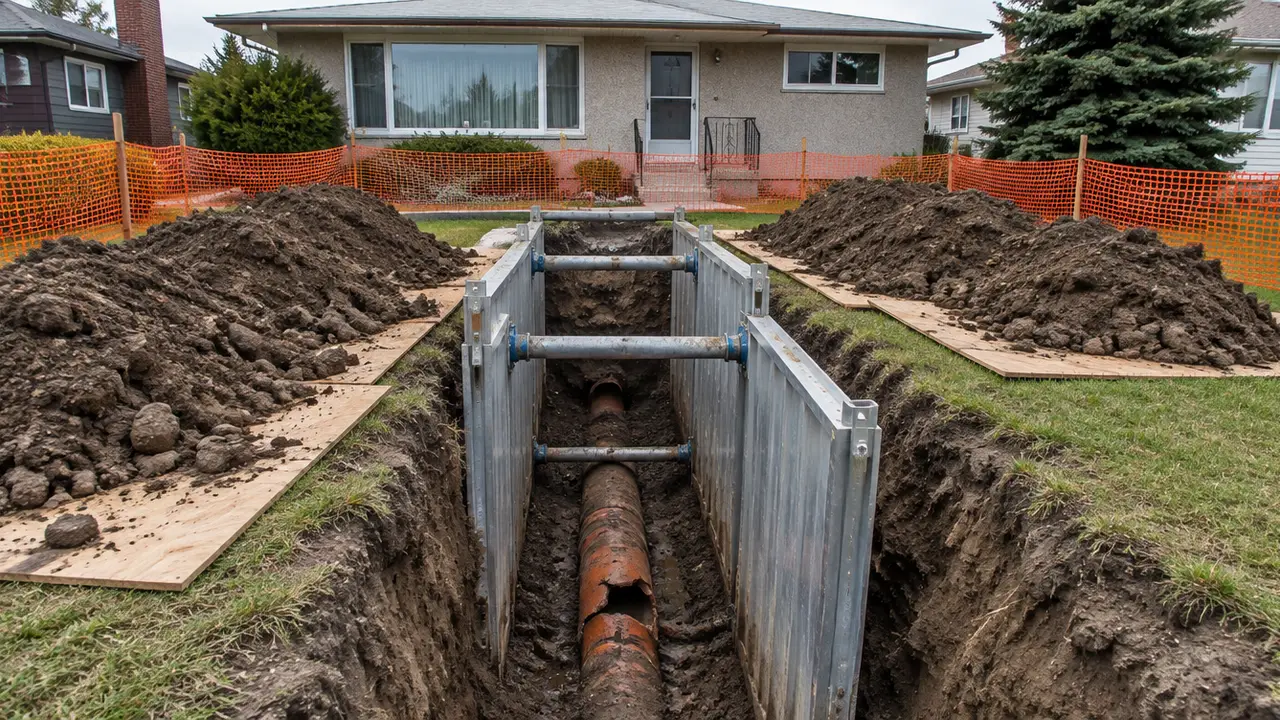
Each material behaves differently when a trench opens, and Alberta's Occupational Health and Safety Code sorts soils into three classes that decide how trench walls must be protected. The Code also says that where more than one soil type is present, the whole excavation is treated as the least stable type.
| Material | How it digs | How it stands | Likely Alberta OHS class | What it means for the job |
|---|---|---|---|---|
| Topsoil and landscaping fill | Easy | Poorly; crumbles | Soft or loose near the surface | Stripped and stockpiled for restoration |
| Clay-rich till, undisturbed | Hard, sticky, dense | Often stands vertical for a while | Hard and compact where it meets the Code's tests | Good bedding support; slow to dig; lumpy when dry or frozen |
| Backfill of the original sewer trench | Easier than native till | Unpredictable | At best likely to crack or crumble, because it was dug before | The route of any replacement; protection is planned for this soil |
| Lake silt and very fine sand | Easy when dry | Flows or runs when wet | Soft, sandy or loose when wet | Walls can slough; dewatering and a trench box are common |
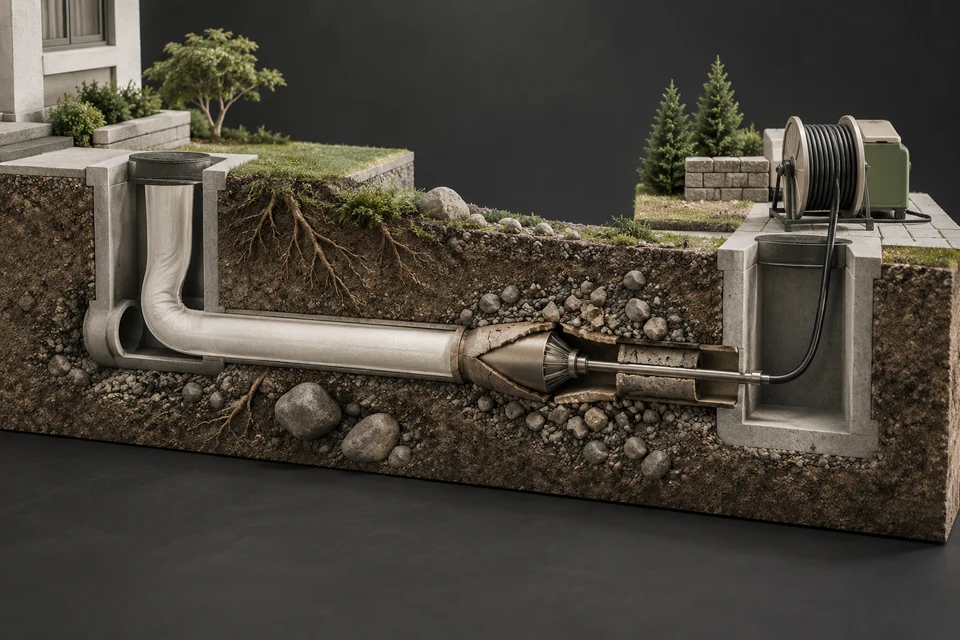
| Quartzite gravel and cobble | Slow; bucket skids on stones | Ravels as stones drop out | Often soft or loose, especially wet | Wider trench; can stall pipe bursting; imported bedding needed |
| Sandstone or mudstone bedrock | Very hard; may need a breaker | Stands well | Solid rock is treated differently only if the whole trench is in rock | Slow and noisy; rare in a typical lateral trench |
The practical upshot is that a Calgary replacement trench is almost never planned as hard and compact soil throughout. It follows the old trench, which was dug when the house was built, and it often cuts through a silt or gravel layer somewhere along the way. Trench safety on a Calgary sewer dig sets out the protection that follows from each class.
03 /How deep are sewer laterals in Calgary?
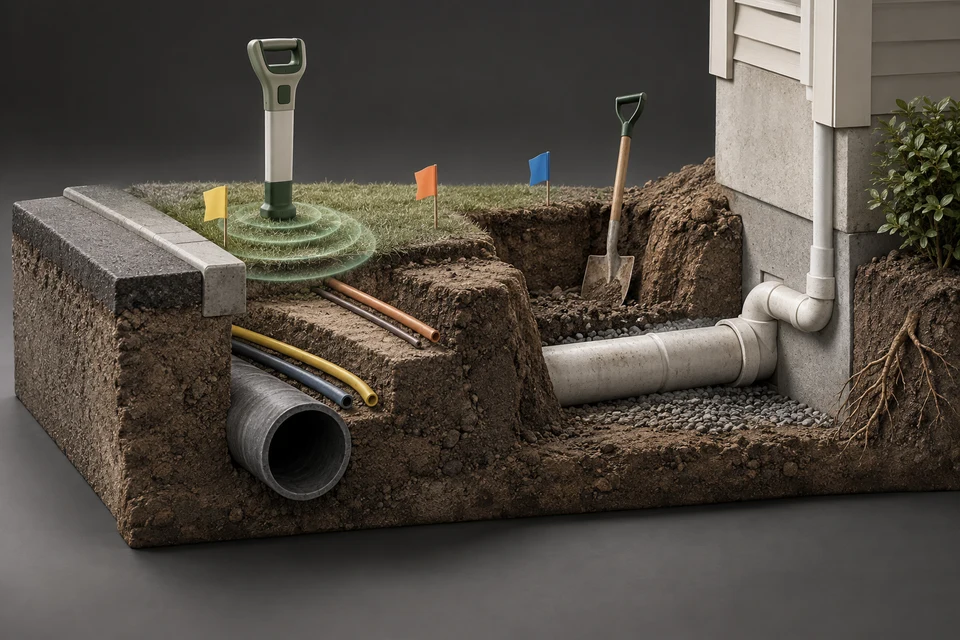
Depth follows the house. In a home with a basement, the building drain runs under the basement floor slab and leaves the house below the footing, so the lateral starts at roughly the basement floor's depth or deeper, then keeps falling toward the City main. That is why laterals from Calgary basement homes commonly read around 2 to 3 m deep at the foundation and often deeper toward the street, while a house without a full basement can have a much shallower line. Treat these as typical figures only; the sonde reading and, finally, the exposed pipe are the real numbers.
| Factor | Effect on depth | What to check |
|---|---|---|
| Full basement | Deep from the start: the drain leaves below the basement floor | Depth at the foundation wall |
| Walkout or partial basement | Varies with grade; can be shallow on the low side | Depth where the pipe leaves the house |
| Slope of the lot | Uphill-to-street lots get deeper toward the street | Depth at mid-yard and at the property line |
| Required fall | The pipe must fall steadily toward the main, adding depth with distance | The designed slope on the permit drawing |
| Depth of the City main | The lateral must reach it; the City section usually continues deeper | The City-side record and camera to the main |
| Frost cover | Shallow sections under cleared surfaces are the ones that freeze | Any section under a driveway, walk or garage apron |
Record depth at three points during the private locate: the foundation wall, mid-yard and near the property line. Those numbers decide trench protection, equipment size and, in practice, a large share of the price. The private locate explains how a sonde reading is taken and why it is an estimate.
04 /What does depth change about the job?
Depth changes how the trench must be protected, which machine can dig it, how much soil comes out and how some trenchless methods behave.
| Depth of the pipe | Trench protection | Method notes |
|---|---|---|
| Less than 1.5 m | Below the Code's 1.5 m protection threshold; walls still watched | Pipe bursting near the surface risks heave; frost is the bigger worry |
| 1.5 m to 3 m | Walls cut back or a protective structure before workers enter, where closer to the wall than the depth | The common Calgary basement-house band; a trench box is typical |
| More than 3 m | Protective structures must be designed by a professional engineer | Open cut becomes costly and disruptive; trenchless worth assessing |
Near the house, depth meets the foundation. Alberta's Code requires that a foundation that may be affected by an excavation be supported by an engineered temporary structure before the excavation begins. The deepest part of a lateral trench is exactly where it meets the house, so ask how the connection at the wall will be made.
05 /Where do groundwater and wet trenches show up?
Water in a trench changes soil class, bedding and schedule. The OHS Code requires that an excavation a worker may enter be kept free of accumulated water that may pose a hazard, and its definition of soft, sandy or loose soil includes granular soil below the water table unless the water has been removed. In Calgary, wet trenches are more likely in a few situations.
- Valley-floor communities along the Bow and Elbow rivers, such as parts of Bowness, Sunnyside, Inglewood and Elbow Park, are more likely to meet river gravels and a shallower water table than upland communities. A test hole tells you for certain.
- Spring snowmelt and summer storms raise shallow groundwater and run surface water into open trenches.
- Chinook thaws in winter release meltwater quickly into frozen ground and open excavations.
- Perched water can sit on top of dense till after rain even where the true water table is deep.
Wet trenches mean pumps, sometimes imported granular bedding and backfill, and a wider or boxed excavation. Ask where pumped water will be discharged; drainage rules are the City's, so confirm through 311 if the contractor plans to pump to a street or lane.
06 /How does frost affect a Calgary sewer dig?
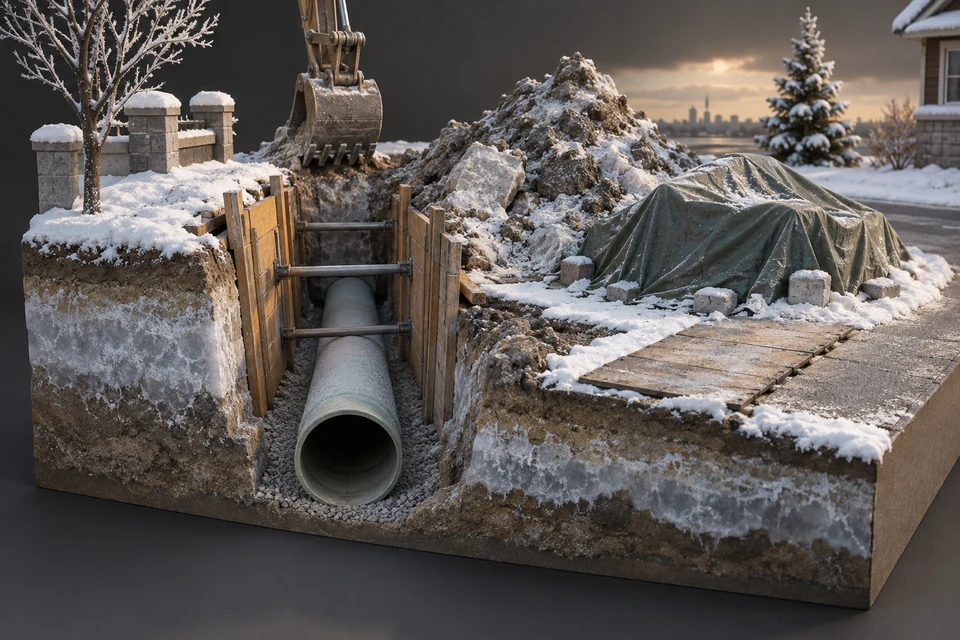
Frost matters twice: it protects deep pipe and threatens shallow pipe, and it slows the start of any winter excavation. Snow cover insulates lawns, while driveways, walks and garage aprons that are kept clear lose that insulation and freeze deeper. A lateral that runs shallow under a front-drive garage or a shovelled walk is the section most likely to freeze in a hard cold snap.
For the dig itself, frozen ground has to be ripped, broken or thawed, and Alberta's Code bars relying on naturally frozen soil in place of trench protection. Winter sewer replacement in Calgary covers the methods, the backfill problem and temporary restoration.
07 /What pipe will the trench meet, community by community?
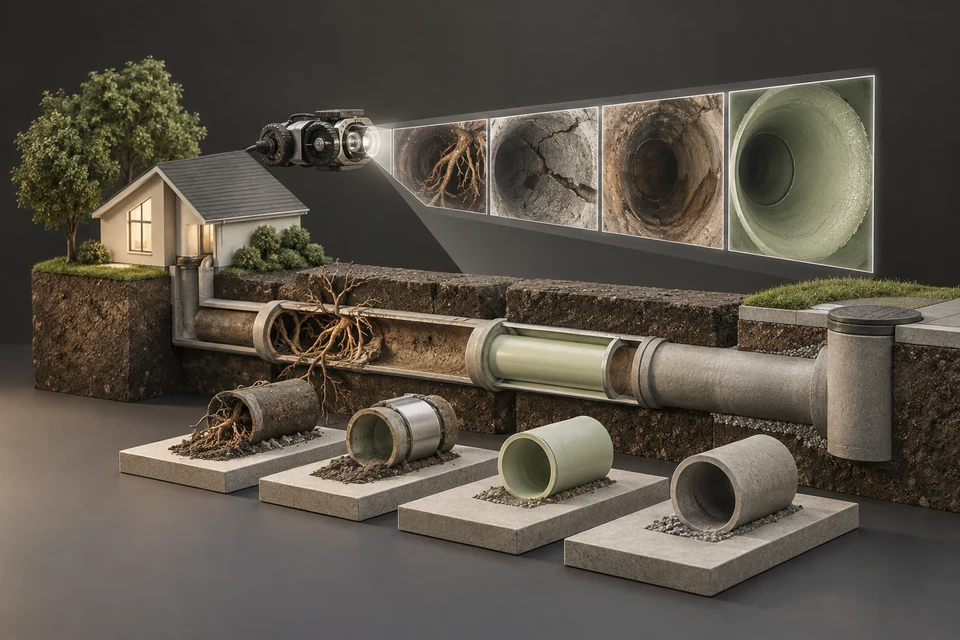
The City's records show what the public section of each service line is made of, and they track Calgary's building eras closely. A HAUSE analysis of the City of Calgary's Public Sanitary Service Lines dataset, covering 367,397 City-owned service lines, shows clay tile dominating City-side installs in the 1960s and 1970s and PVC taking over in the 1980s. Those records cover only the City-owned portion from the main to the property line. Your private portion can be a different material and a different age, and the camera is how you confirm it.
| Decade | PVC | TIL (generally clay tile) | Cast iron | OTHER | CIPP (relined) |
|---|---|---|---|---|---|
| 1950s | 63 | 5,775 | 4,179 | 6,826 | 29 |
| 1960s | 38 | 23,376 | 3,734 | 2,542 | 27 |
| 1970s | 11,091 | 43,777 | 3,465 | 984 | 8 |
| 1980s | 29,981 | 1,158 | 802 | 45 | 1 |
| 2010s | 48,087 | 4 | 2 | 131 | 832 |
| 2020s | 33,959 | 13 | 2 | 4 | 3,153 |
TIL is the City's tile code, generally read as clay tile. OTHER and some other codes are not defined in the City's metadata, and most pre-1950 records carry OTHER. For CIPP, the record date is usually the relining date, so those lines are older City sections renewed in place. The 1950s row also includes 6,290 lines coded TP, a code the City does not define; it appears almost entirely on 1950s and 1960s installs.
| Community | City-side lines | Median install year | What stands out |
|---|---|---|---|
| Maple Ridge | 808 | 1966 | 99.1% TIL |
| Lake Bonavista | 3,272 | 1971 | 93.3% TIL |
| Rosscarrock | 1,008 | 1963 | 56.6% cast iron |
| Bowness | 3,571 | 1968 | 41.6% cast iron |
| Highwood | 865 | 1956 | 22.1% relined (CIPP) |
| Rosedale | 592 | 1950 | 56.1% installed before 1960 |
At the property line, your new pipe will join whatever the City section is. Knowing the likely material before the dig lets your contractor bring the right transition coupling and plan the connection. If a City record looks wrong, the City asks for corrections through 311. CalgarySewers.ca covers these records community by community; the scope guide shows how to use them when planning a job.
08 /What should you ask your contractor about the ground?
- What depth did the locate show at the foundation, mid-yard and property line?
- What soil do you expect, and have you dug nearby recently?
- How will the trench be protected past 1.5 m, and will any part pass 3 m?
- What happens if you hit wet silt, gravel or cobble: pumping, a wider box, imported bedding?
- Will native soil go back in, or imported granular fill, and why?
- How will the connection at the foundation be dug, and does the foundation need support?
- If the job is in winter, how will frost be handled and what restoration is temporary?
The answers shape the timeline as much as the price. Run them through the Replacement Timeline Planner, then request quotes with your depths and footage attached so every contractor starts from the same ground truth.
FAQQuestions people ask
How deep is a sewer line in Calgary?
It depends on the house. In a basement home the lateral leaves below the basement floor, so depths around 2 to 3 m or more are common, increasing toward the street. A sonde reading gives the estimate for your line.
What kind of soil is Calgary built on?
Mostly glacial till with clay, lake sediments of silt and very fine sand, and in many places quartzite gravel or hard sandstone under a thin cover, according to the Alberta Geological Survey's mapping of the urban area.
Why do Calgary sewer trenches need shoring?
Most laterals are deeper than 1.5 m, where Alberta's OHS Code requires walls to be cut back or protected before workers enter, and the replacement trench usually follows previously dug ground.
Does cobble affect trenchless replacement?
It can. Cobble and boulders can stall or deflect a pipe-bursting head. Lining is less affected because it works inside the existing pipe.
Do the City's records show my private sewer pipe?
No. They cover only the City-owned section from the main to the property line. Your private section can be a different material and age.
Is groundwater a problem for sewer digs in Calgary?
Sometimes, especially on valley floors near the rivers, during snowmelt and after storms. Wet trenches need pumping and often a trench box and imported bedding.