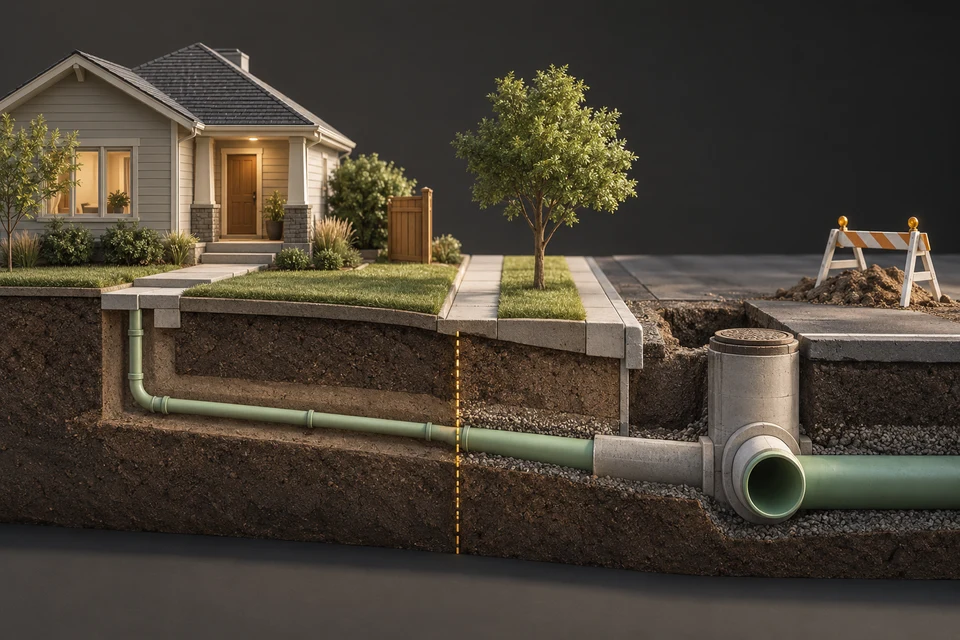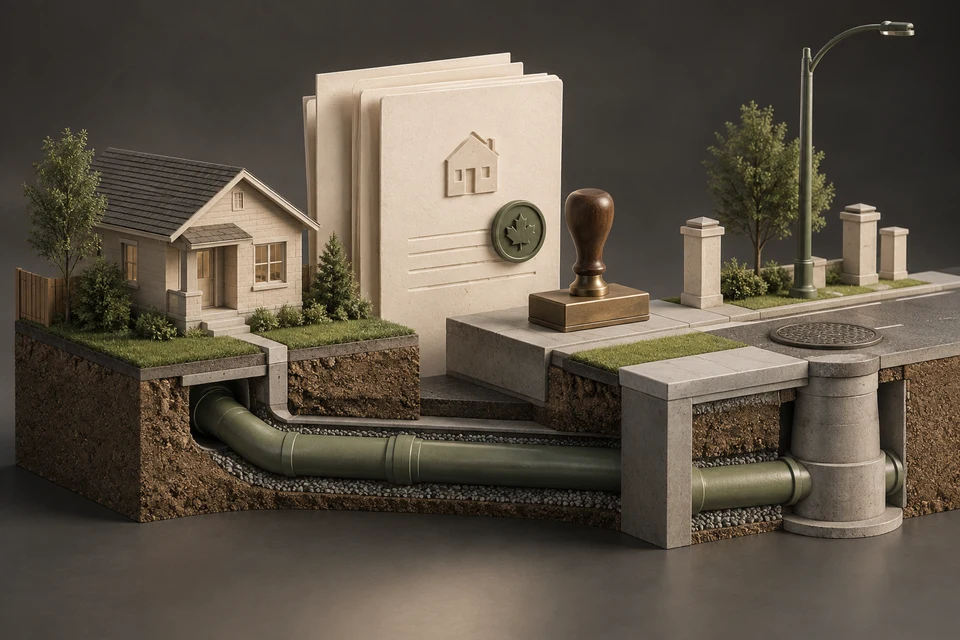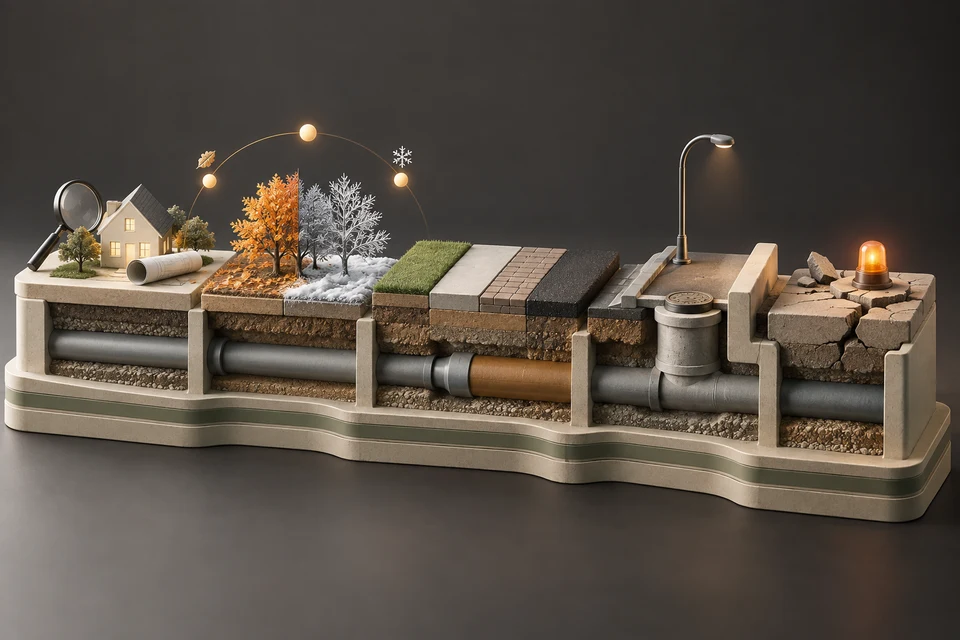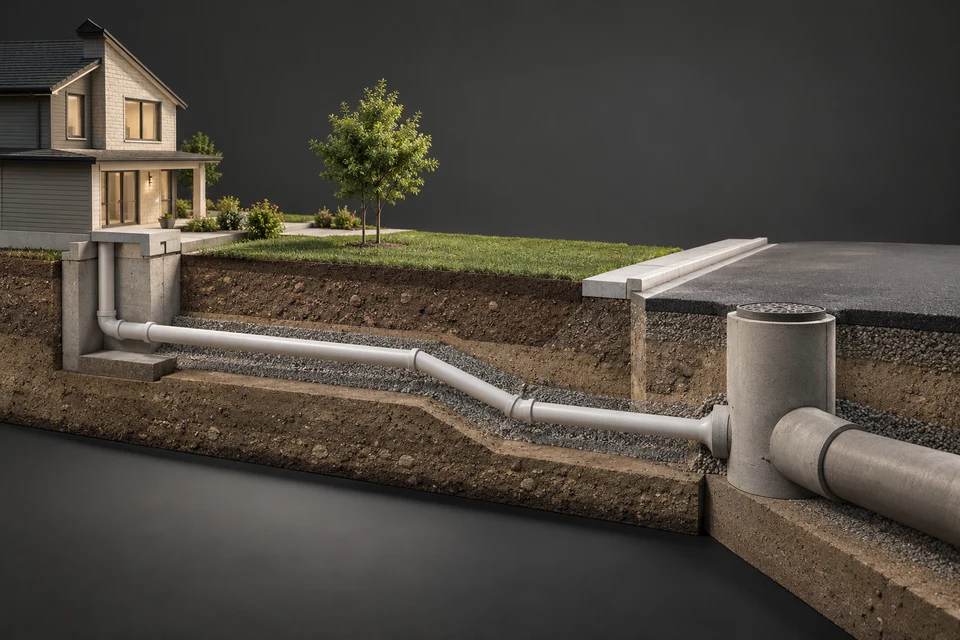
A new sewer line to the street in Calgary has two parts. The owner's contractor builds the private pipe from the house to the property line under a permit, with at least 4.5 ft of cover and City grade and bedding rules. The connection in the City right-of-way must be installed by a contractor on the City's indemnified list. Old services are reused only if the City approves.
- New services usually come with a rebuild, an infill, a lot split or an existing line judged inadequate; the City recommends assessing existing lines for every renovation and infill.
- Owners, builders and developers must hire a utility indemnified contractor for service connections in City rights-of-way.
- The City's demolition guide puts all new connections, including replacements, upgrades and required disconnections, public and private portions, at the lot owner's expense.
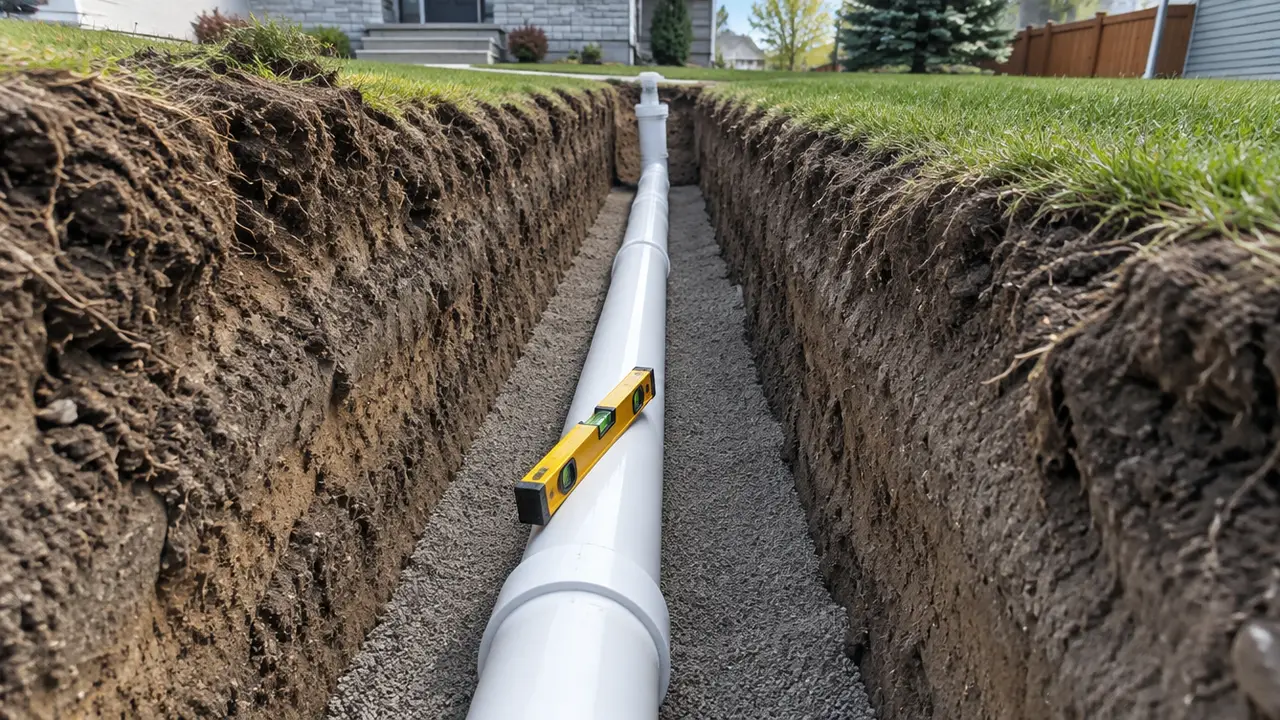
- City infill guidance sets 4.5 ft of cover for sanitary services, minimum grades by pipe size, and bedding of hard particles no larger than 20 mm, never sand.
- New single and semi-detached homes can use the quick trench program, with photos uploaded before backfill; otherwise a City safety codes officer inspects on site.
01 /When does a Calgary lot need a new sewer service instead of a replacement?
A replacement renews the pipe you already have along roughly the same route. A new service is a different job: a new connection point, a new route or a new size, often with the old line taken out of use. In Calgary that usually comes up when a house is demolished and rebuilt, when one lot becomes two homes, or when the existing line cannot serve what is being built.
| Situation | Why the old line may not do | First question for the City |
|---|---|---|
| Demolition and rebuild on the same lot | The old service may be the wrong depth, size or position for the new foundation | Can the existing service be re-used, and on what conditions? |
| Lot split into a semi-detached pair or two houses | Each home may need its own connection | How many services does the approved plan require? |
| Major renovation adding fixtures or a suite | The existing line may be old clay or undersized for the new layout | Does the permit review call for the existing line to be assessed? |
| Existing line failed and rerouting is simpler | A new route avoids a garage slab, a tree or a shared section | Will the City connection point change? |
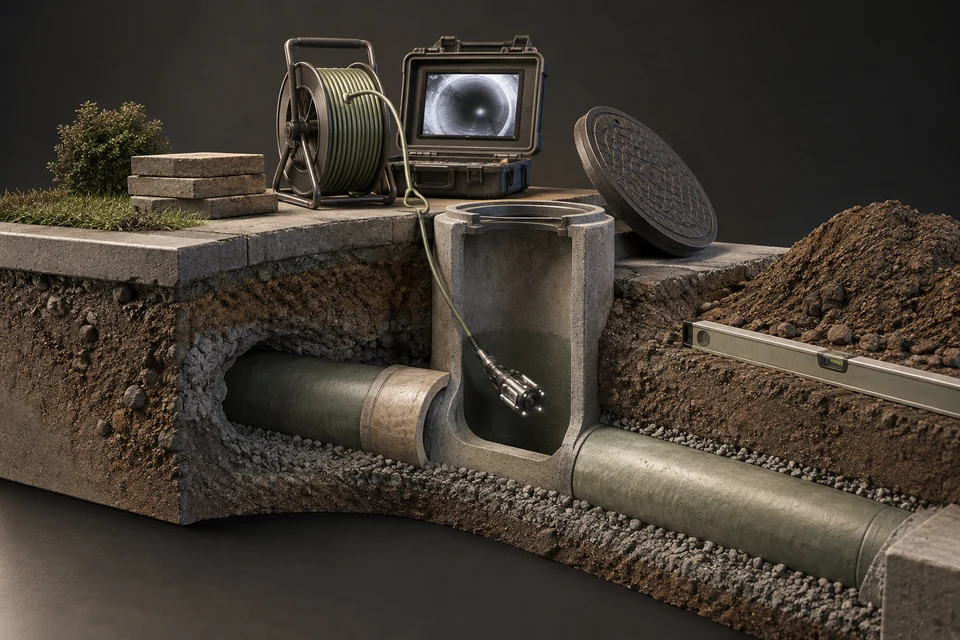
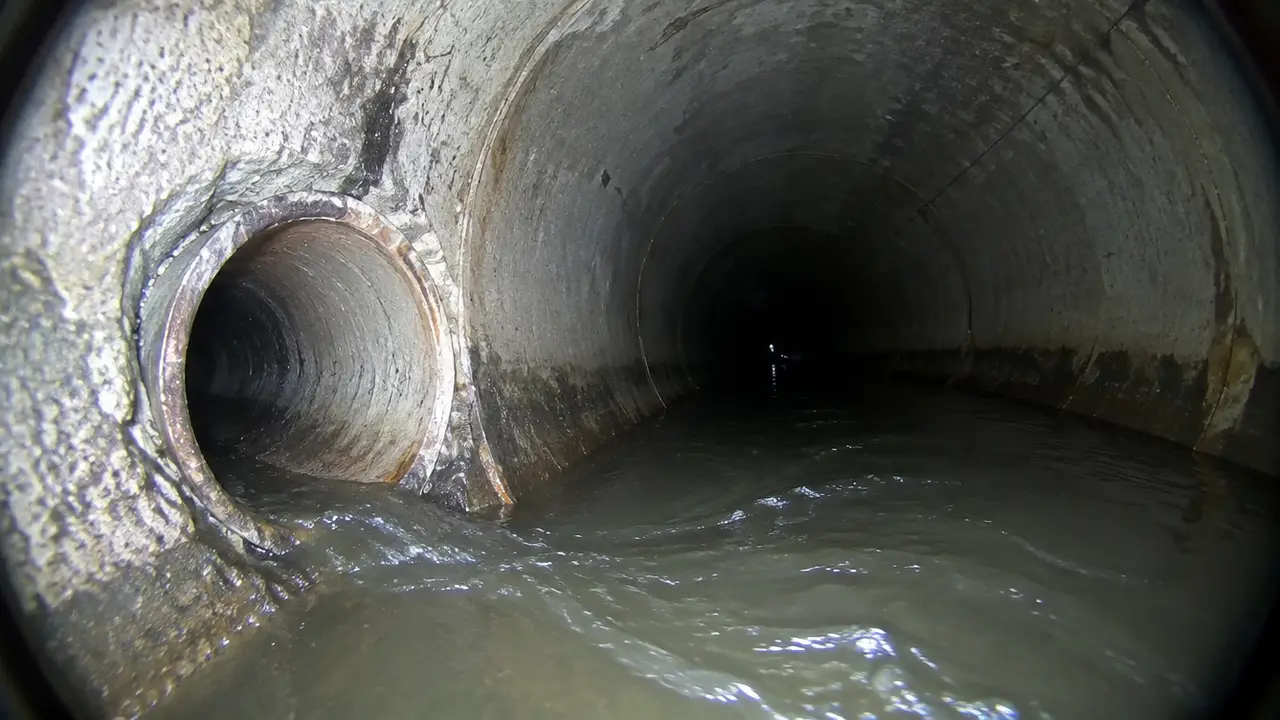
The City's demolition permit guide recommends that for all renovations and infills, the owner or developer assess the adequacy of the existing on-site water and sewer lines and replace them if they are inadequate, and it points to 311 for more information. A camera run of the old line before design saves a hard conversation after the foundation is poured.
02 /Who builds which part of a new service?
The line splits at the property line, and so does the work. The City's page on installing water and sewer connections says builders or homeowners are responsible for providing the service connections from the property line to the plumbing system, built by their contractor at their expense and in compliance with the applicable bylaws.
The part in the road or boulevard has an extra gate. The City's Utility Master Indemnification Agreement page says developers, home builders and homeowners requiring water, sanitary or storm service connections in City rights-of-way must hire a utility indemnified contractor, and it gives protecting City infrastructure and public health and safety as the reasons. Work on City land also brings its own permits; working on the City side covers excavation permits, boulevard restoration and tree protection.
03 /What happens to the old service when a Calgary house comes down?
It has to be dealt with before demolition, and water leads. The City's demolition permit guide asks owners who are not developing within two years to have an indemnified contractor disconnect the water service at the watermain, then call 311 for a Water Off-On appointment to remove the meter. Owners who are developing within two years book the 311 appointment instead.
- Two-year clock: the guide says you have two years from the initial 311 call to disconnect the water line, and one year to obtain a development permit if you do not hold a current one.
- Re-use needs approval: the City's disconnection page says a water service can only be re-used if The City approves it.
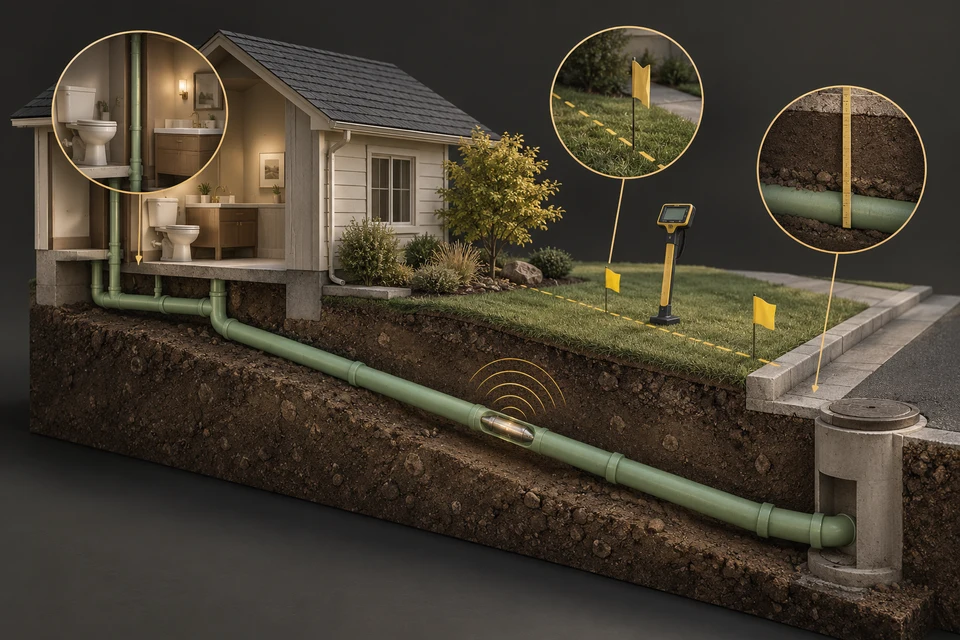
- Finding the old service is on you: the guide makes the lot owner or engineer of record responsible for locating the existing service and recording the last known location of its valves. Finding where your sewer line runs covers the tracing methods.
- Who pays: the same guide states that all new service connections, including replacements, upgrades and required disconnections, public and private portions, are at the lot owner's expense.
- The sewer side: the City's sewer construction specifications include provisions for abandoning old services. Ask the City what your lot requires rather than assuming an unused sewer can simply be left in the ground.
Gas and electrical removals run on their own timelines and sign-offs, which is why disconnections are usually the first line on an infill schedule, well ahead of any sewer work.
04 /What does the City require of the new private sewer pipe?
The City's page on plumbing and gas for infill construction lists the key trench and piping rules for new services. They are the numbers an inspector or a quick trench photo will be checked against, so ask your contractor to confirm each one in writing.
| Item | City requirement | What it means on site |
|---|---|---|
| Cover over a sanitary service | Frost protection of 4.5 ft (about 1.4 m) | A minimum; a basement home's drain exits deeper than this anyway |
| Cover over a water service | Frost protection of 8.5 ft (about 2.6 m) | The water line may sit below the sewer in a shared trench layout |
| Grade, 3 in (75 mm) pipe | At least 1 in 50 | About 2 cm of fall per metre |
| Grade, 4 in (100 mm) pipe | At least 1 in 100 | About 1 cm of fall per metre |
| Deflection | Not more than five degrees every 3 m | Gentle bends only; sharp changes need fittings |
| Bedding | Hard durable particles no larger than 20 mm, free of clay lumps, organics and frozen material; sand is not acceptable | Imported granular bedding, not trench spoil |
| Bedding thickness | At least 4 in (100 mm) under the pipe and 12 in (300 mm) of cover | Measured before native backfill goes in |
For context, 346,717 of the 367,397 active City-side sanitary records in the City's open data were listed at 100 mm in September 2026, so a 4-inch private line meeting a 100 mm City connection is the normal Calgary pattern. Frozen material in the bedding is specifically excluded, which is one reason winter work needs imported, thawed bedding.
05 /How are new service trenches inspected in Calgary?
There are two routes for a new house's sanitary and storm services, and both happen before backfill. The City's infill page says a qualified quick trench contractor can excavate and install water, sewer and storm piping for new single and semi-detached homes under the program's conditions; otherwise the check is a site inspection by a City safety codes officer.
- Quick trench photos
Every trench is photographed before backfilling, converted to PDF and uploaded by the builder to the residential ePermit site. The photos must show the site location, pipe size and material, and the backfill material.
- Site inspection
Where quick trench does not apply, a City safety codes officer inspects the open trench. The permit holder books it, and the trench stays open until it passes.
- Right-of-way connection
The City's connection page says it inspects connections to its infrastructure under the Master Indemnification Agreement, against its standard specifications and the approved plans.
For a repair or replacement on an existing house, the inspection route is the one described in inspections on a Calgary sewer replacement. The quick trench program is tied to new single and semi-detached homes.
06 /In what order does a new sewer service usually get built?
On a typical Calgary infill the sewer is not a standalone job; it slots into the building sequence. The order below is a general pattern, and your permits and builder set the real one.
- Camera the existing line and decide, with the City, whether it can be re-used.
- Disconnect utilities for demolition, water first, following the City's disconnection process.
- Obtain the development and building permits that define the new services.
- Request public locates through Utility Safety Partners and a private locate for anything still buried on the lot.
- Have the indemnified contractor build the connection in the right-of-way under its City permits.
- Build the private service to the foundation at the required depth, grade and bedding.
- Photograph under quick trench, or hold for the safety codes officer's inspection.
- Backfill in compacted lifts and keep the trench line clear of heavy traffic while it settles.
- File the as-built measurements, photos and permit records with the house documents.
Locate lead time, permit review and the right-of-way contractor's schedule are the usual waits. The Replacement Timeline Planner models the City-side step with a longer permit range, which is a reasonable starting assumption for a new connection as well.
07 /What does it cost to run a sewer line to the street?
There are two bills. The private pipe from the foundation to the property line is dug, laid and restored much like an open-cut replacement, which this site plans at roughly $14,000 to $40,000 CAD for a residential lateral. The connection in the right-of-way is quoted separately by the indemnified contractor and brings excavation permit fees and City restoration standards on top.
Infill budgets, redevelopment and property questions are covered at CalgarySewerReplacement.com, and national new-connection guidance sits on the Sewers.ca hub. When your plans are drawn, request quotes for the private service with the permit drawings attached.
FAQQuestions people ask
Can I reuse the existing sewer service for my Calgary infill?
Possibly, but only on the City's terms. The City recommends assessing the adequacy of existing water and sewer lines for every renovation and infill, and says a water service can only be re-used if it approves. Camera the old line and ask the City before design.
Who installs the sewer connection in the road for a new Calgary house?
A contractor on the City's utility indemnified list. The City says developers, home builders and homeowners needing service connections in City rights-of-way must hire one.
What is Calgary's quick trench program?
An inspection route for new single and semi-detached homes in which a qualified quick trench contractor installs the water, sewer and storm piping and uploads photos of each trench to the residential ePermit site before backfill.
How deep must a new sewer service be in Calgary?
The City's infill guidance sets frost protection of 4.5 ft of cover for sanitary services and 8.5 ft for water services. Basement homes usually need the sewer deeper than that minimum to leave below the slab.
Who pays for the City-side part of a new connection?
The lot owner. The City's demolition permit guide states that all new service connections, including replacements, upgrades and required disconnections, public and private portions, are at the lot owner's expense.
Can sand be used to bed a new sewer pipe in Calgary?
No. The City's infill page says bedding in sand is not acceptable and calls for hard, durable particles no larger than 20 mm, free of clay lumps, organics and frozen material.
NETWORKGo deeper across the HAUSE Sewer network
Sewer Backup Checklist
Sewer Backup Checklist: 24 steps in six stages, from making it safe to after cleanup, with a progress meter and a copy-ready summary for your insurer.
SewerQuotes.comNew sewer line cost: new connections, infill services and septic-to-sewer
New sewer line cost in Canada (2026): CAD planning ranges for new house connections, infill services and septic-to-sewer conversions, plus fees to confirm.
SewerInspector.caCCTV sewer inspection: crawlers, lateral launch cameras and coded surveys
What CCTV sewer inspection is: crawler cameras, lateral launch and zoom cameras, PACP-coded municipal surveys, and what city camera work means for your lateral.