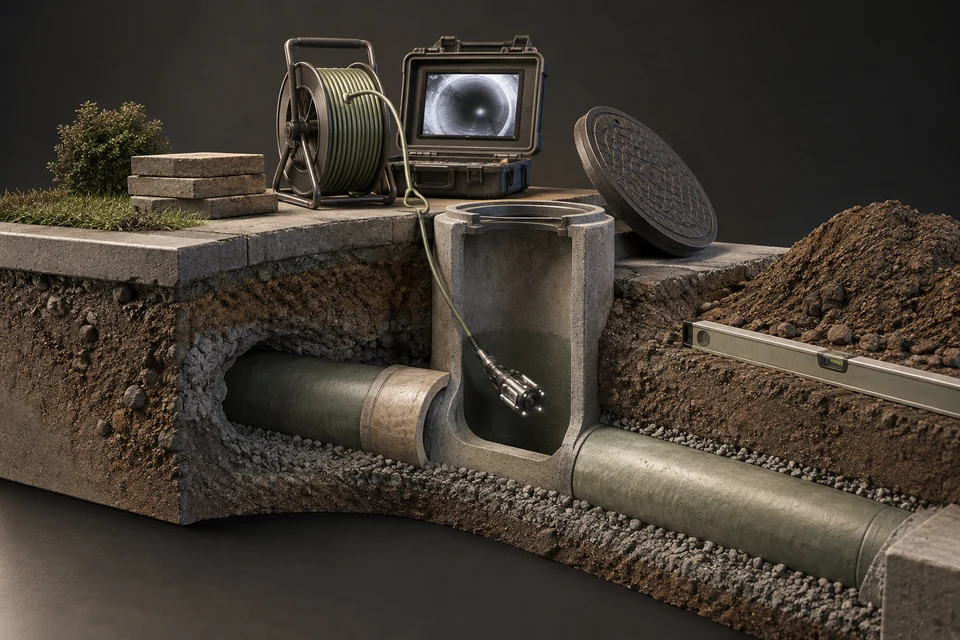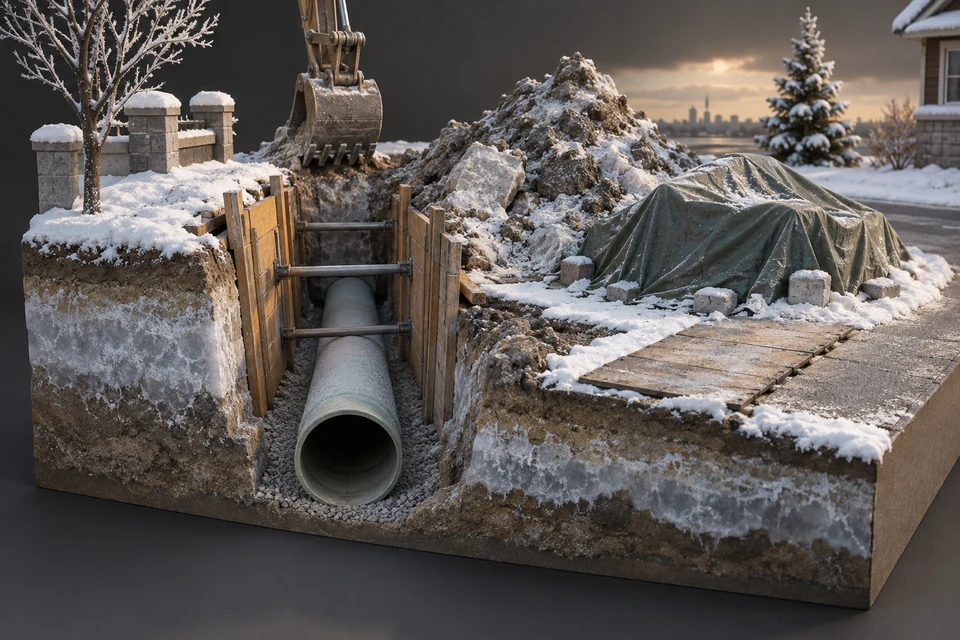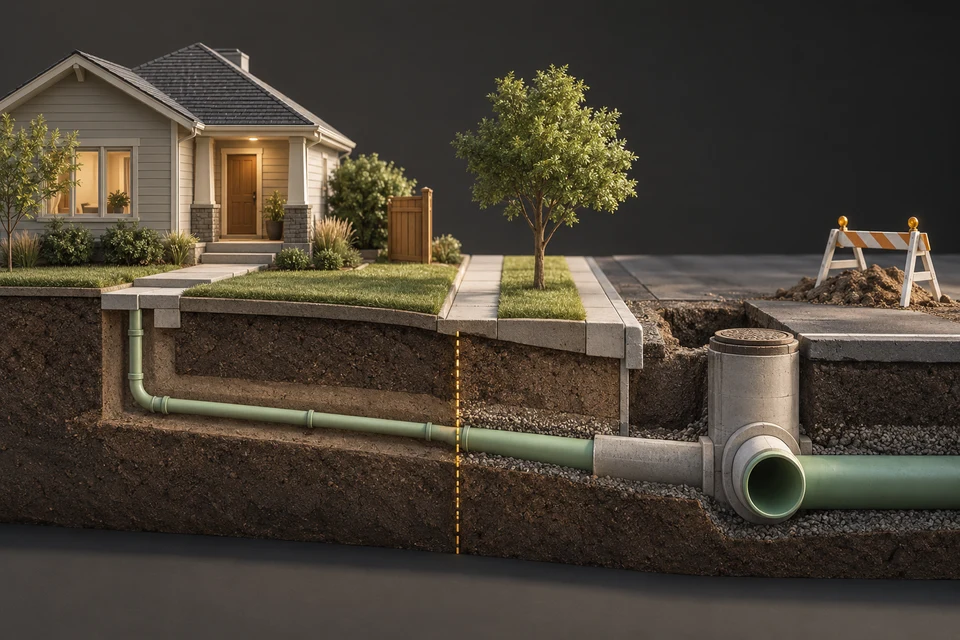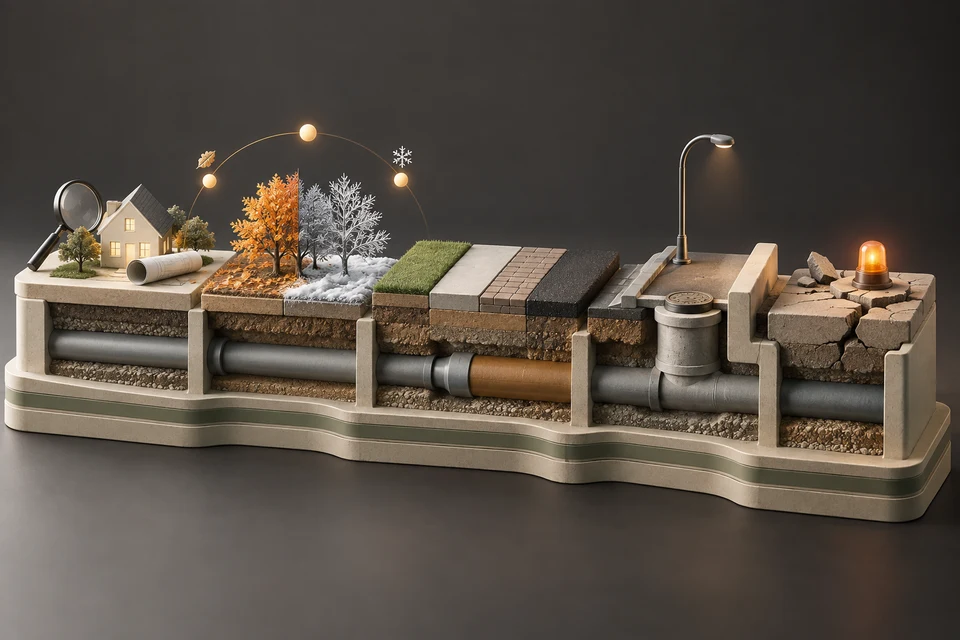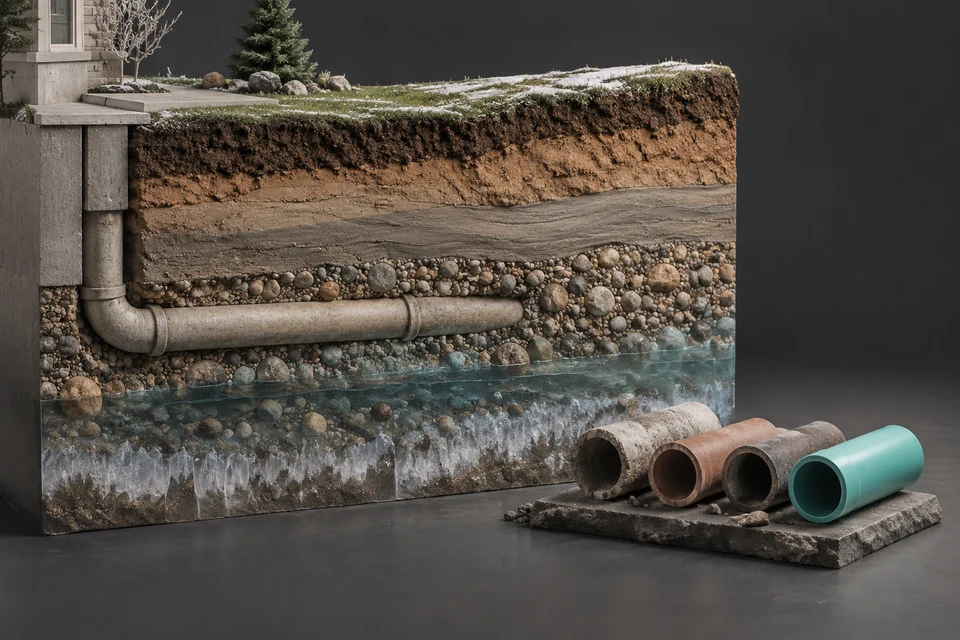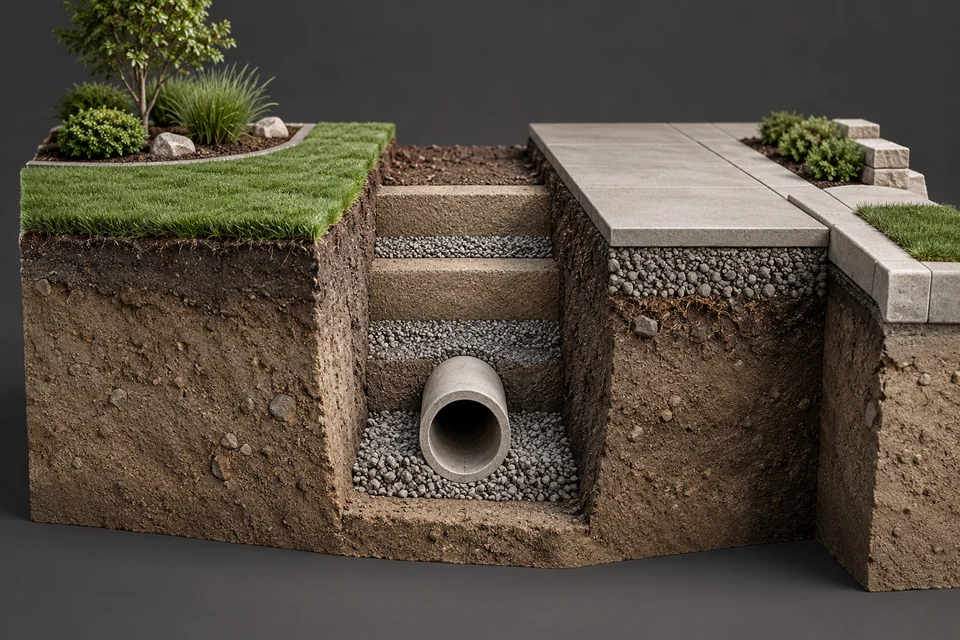
After inspection, a Calgary sewer trench is backfilled in layers: bedding and select material around the pipe, then native or imported fill placed and compacted in lifts. Clay-rich soil settles for months, so good crews leave the surface slightly high, restore lawns with topsoil and seed or sod, and delay concrete until the trench has settled. Write the restoration scope and a settlement top-up into the contract.
- Backfill goes in compacted lifts; dumping a trench full and running a machine over the top is how hollows appear in spring.
- Calgary clay compacts well only near the right moisture; very wet or frozen soil is often replaced with granular fill.
- Lawns can be seeded right away but usually recover fully the following season.
- Concrete over a sewer trench should wait for settlement and a compacted base, then needs days to weeks to pour and cure.
- On City land, the excavation permit holder remains responsible for the trench backfill for a two-year period, according to the City's permit page.
01 /How should a sewer trench be backfilled?
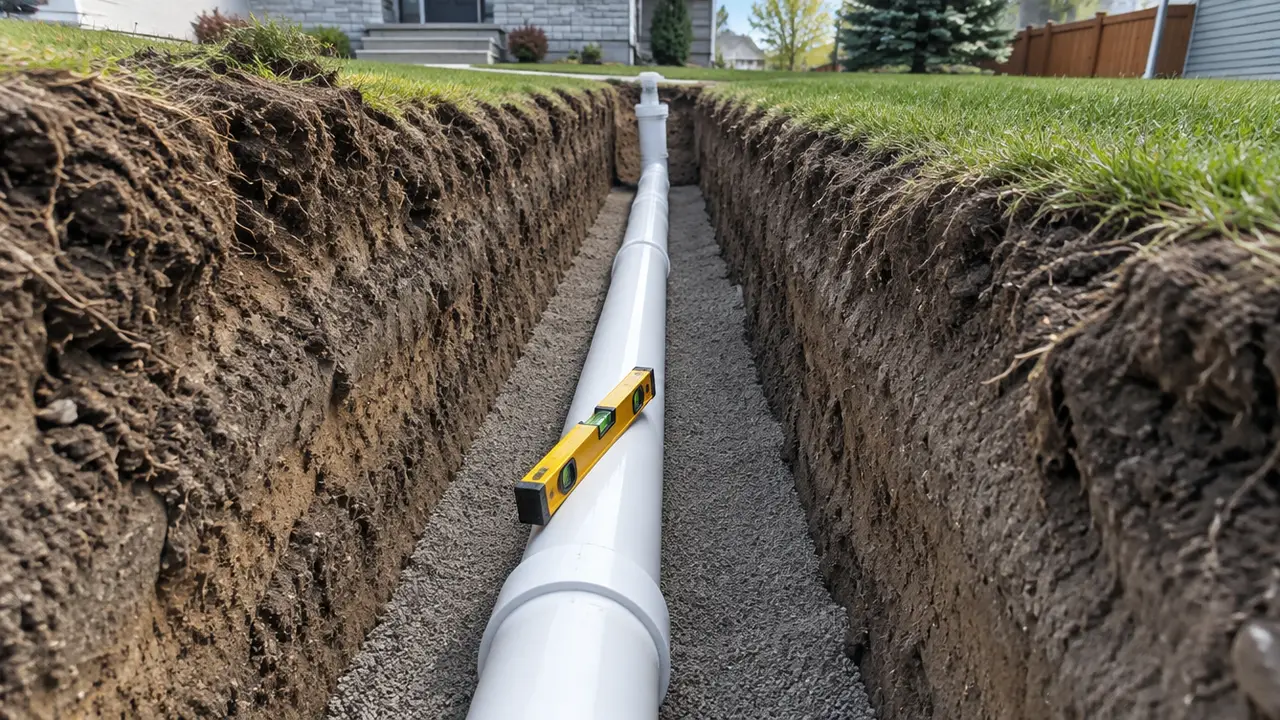
A sewer trench is backfilled in zones, from the pipe up, and each zone has a different job. The material around the pipe holds it on grade and protects it; the fill above supports the surface; the top layer grows grass or carries a slab. Mixing up those jobs is what produces a sunken strip across the lawn or a cracked driveway a year later.
| Zone | What goes in | How it is placed | What goes wrong |
|---|---|---|---|
| Bedding | Granular material shaped to the pipe | Levelled to grade before the pipe is laid | Rocks or voids under the pipe create dips |
| Pipe zone (haunches and initial cover) | Select granular or screened fill free of stones | By hand or carefully, worked under the sides of the pipe | Heavy material dropped on the pipe knocks it off grade |
| Trench backfill | Native soil if suitable, or imported granular | In lifts, each compacted before the next | Thick lifts or wet clay leave soft layers that settle |
| Surface layer | Topsoil for lawns; compacted base for hard surfaces | Graded slightly high over the trench | Sub-base not compacted under concrete |
The lift thickness and compaction method depend on the material and the equipment. What matters to you is that the contract says backfill will be placed and compacted in layers, and that you see a compactor working as the trench fills, not only at the end.
02 /Why do trenches in Calgary clay settle?
Clay-rich soil only compacts well within a band of moisture. Too wet and it squeezes and pumps under a compactor; too dry and it breaks into hard lumps with air between them; frozen and it will not compact at all. Excavated Calgary till often comes out of the trench at a different moisture from ideal, especially after rain, snowmelt or a chinook.
- Some settlement is normal, even in a well-compacted trench, as the soil consolidates through its first wet season.
- Frozen backfill from a winter job settles as it thaws; see winter replacement.
- Wet trenches near the river valleys or in silty ground may need imported granular fill to compact properly; the soils and depth page describes where that is more likely.
- Leftover spoil after backfill is normal because pipe, bedding and imported fill take up space the old soil occupied. It is hauled away, not spread across your yard, unless you agree otherwise.
03 /How are lawns and landscaping restored?
A lawn can be restored immediately, but a new lawn over a trench is not a finished lawn until it has had a growing season. The Replacement Timeline Planner plans lawn restoration as topsoil and seed now, with full recovery the next season.
| Surface | Common restoration | Timing and notes |
|---|---|---|
| Lawn, seeded | Topsoil over the trench, raked, seeded and watered | Quickest and cheapest; patchy until it fills in; best in spring or late summer |
| Lawn, sod | Topsoil, then new sod or the original sod if it was cut and kept moist | Looks finished sooner; needs watering; original sod survives only short delays |
| Planting beds | Plants lifted and heeled in, then replanted with new soil and mulch | Replant after settlement where possible |
| Trees near the trench | Protected during work; roots cut cleanly if unavoidable | City trees within six metres of work need a City tree protection plan |
| Paving stones and walks | Stones stacked and relaid on a rebuilt, compacted base | Relay after settlement or accept a later re-level |
| Fences and decks | Panels removed and reinstalled; posts reset | Confirm who resets posts and how footings are compacted |
Trees need the most thought. Most of a tree's absorbing roots sit in the upper soil, so a trench beside a mature tree can harm it even if the trunk is untouched. If a City tree stands near the work, the City's tree protection plan requirement applies within six metres; for your own trees, ask the contractor how the trench will be routed and how cut roots will be handled.
04 /How are driveways and concrete restored?
Concrete is the one surface that should not be rushed. A slab poured on a trench that has not finished settling will crack along the trench edges, sometimes within the first winter. The planner describes driveway and concrete restoration as taking a few days to weeks for the pour and cure, and in winter restoration is often temporary until spring.
- Saw-cut clean edges
The existing slab is cut in straight lines beyond the trench so the patch bears on undisturbed base, not on trench fill.
- Build a compacted base
Granular base placed and compacted over the trench, to the same standard as the rest of the drive.
- Tie in the new concrete
Dowels or other ties into the existing slab where the contractor's method uses them, and reinforcement as specified.
- Pour and finish
Matching thickness and finish as closely as practical; exact colour matches are rare on older concrete.
- Cure
Keep traffic off until the contractor says the slab is ready. Cold weather lengthens curing and requires protection.
Some owners use the opportunity to replace a whole panel or the whole driveway rather than patch it. That is a design and budget choice, not a sewer requirement; get it priced separately so it does not blur the sewer quote. CalgarySewerReplacement.com covers how surfaces change Calgary replacement costs.
05 /Who restores the boulevard, sidewalk or road?
Restoration on City land follows the excavation permit. The City's excavation permit page says each permitted site is inspected, that the permit holder is responsible for maintaining the trench backfill for a two-year period, and that work done in winter may need temporary repairs with the permit holder returning to complete final repairs when conditions allow. It also describes City paving work over asphalt cuts and fees charged to the permit holder, including pavement degradation fees for cuts in asphalt.
If your job involves City land, the contract should say who holds the excavation permit, who restores the boulevard and sidewalk, and who handles the two-year backfill responsibility. More on that in working on the City side.
06 /What should the restoration scope in your contract say?
Restoration is where quotes diverge most quietly. “Restore to original condition” means different things to different contractors, and “rough grade only” means you are doing the rest. Make each surface a line item.
- Each surface over or beside the trench, and what it will be restored to.
- Who supplies topsoil, seed, sod, pavers, concrete and plants.
- Whether original sod or pavers will be saved and reused.
- Timing: now, after settlement, or next spring for winter work.
- A settlement top-up visit and what it includes.
- Who restores City land and holds the permit for it.
- Photos of the finished surfaces as part of the handover.
The Permit & Locate Checklist includes getting the restoration scope and timing in writing, because it is the item owners most often find missing after the crew has left. When you are comparing firms, request quotes that break restoration out surface by surface.
FAQQuestions people ask
How long will my lawn take to recover after a sewer replacement?
Seeded lawn over a trench usually fills in over the following growing season. Sod looks finished sooner but still needs watering and may need topping up where the trench settles.
When can a driveway be poured after a sewer replacement?
After the trench has settled and a compacted base is in place. The pour and cure take a few days to weeks, and winter pours need cold-weather protection or a spring date.
Why is there a mound over my new sewer trench?
Good crews leave the backfill slightly high because it settles. The mound should drop over the first season; a settlement visit levels whatever remains.
Can the dirt from the trench all go back in?
Not always. Wet, frozen or rocky material may be replaced with imported granular fill, and there is usually surplus soil to haul away.
Who fixes the boulevard after a sewer dig?
The holder of the City excavation permit is responsible for the right-of-way restoration and, according to the City's permit page, for the trench backfill for a two-year period.
NETWORKGo deeper across the HAUSE Sewer network
How tree roots get into sewer pipes
How tree roots get into sewer pipes: vapour leaks at joints, the soft backfill trench, and why clay and concrete laterals fail first, with depth and fixes.
SewerQuotes.comSewer line replacement cost: open-cut vs trenchless, line by line
Sewer line replacement cost in Canada for 2026: open-cut, CIPP lining and pipe bursting planning ranges in CAD, per-metre math, line items and what moves price.
PipeCleaning.caBaking soda and vinegar for drain pipes: what the fizz really does
Does baking soda and vinegar clean drain pipes? What the reaction does, when it helps, which vinegar to use, and why salt and boiling water fall short.