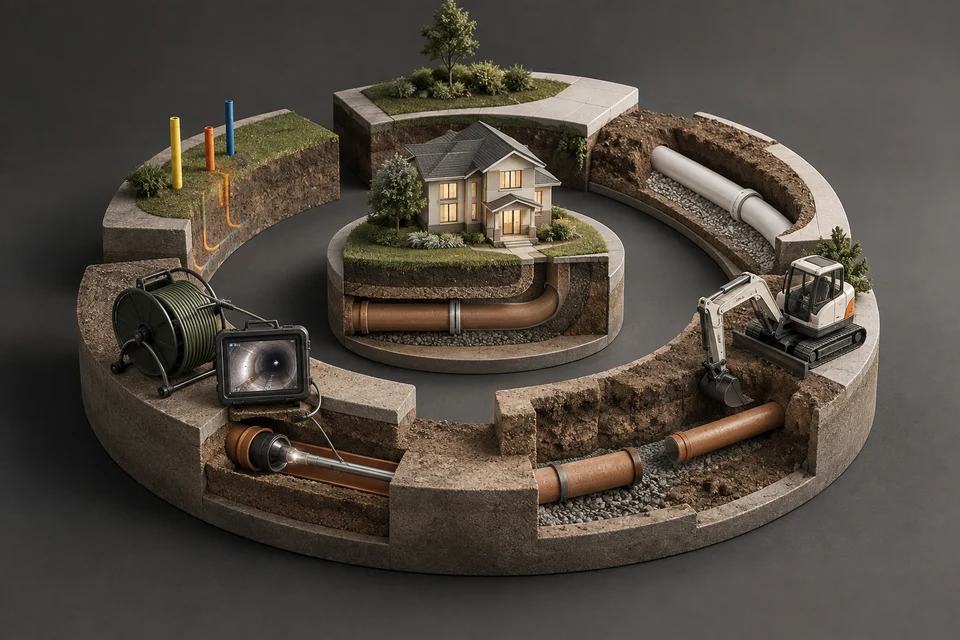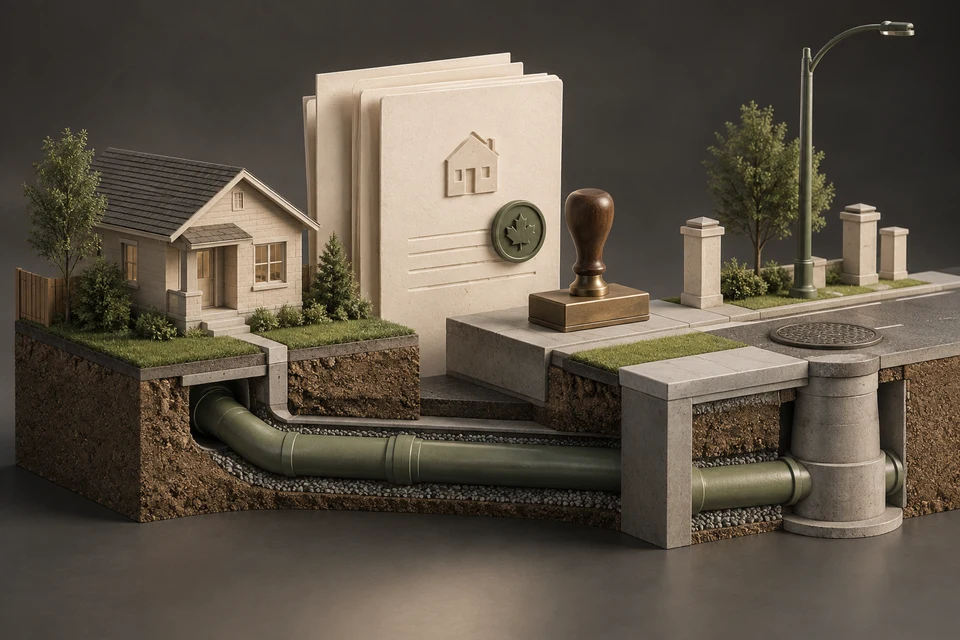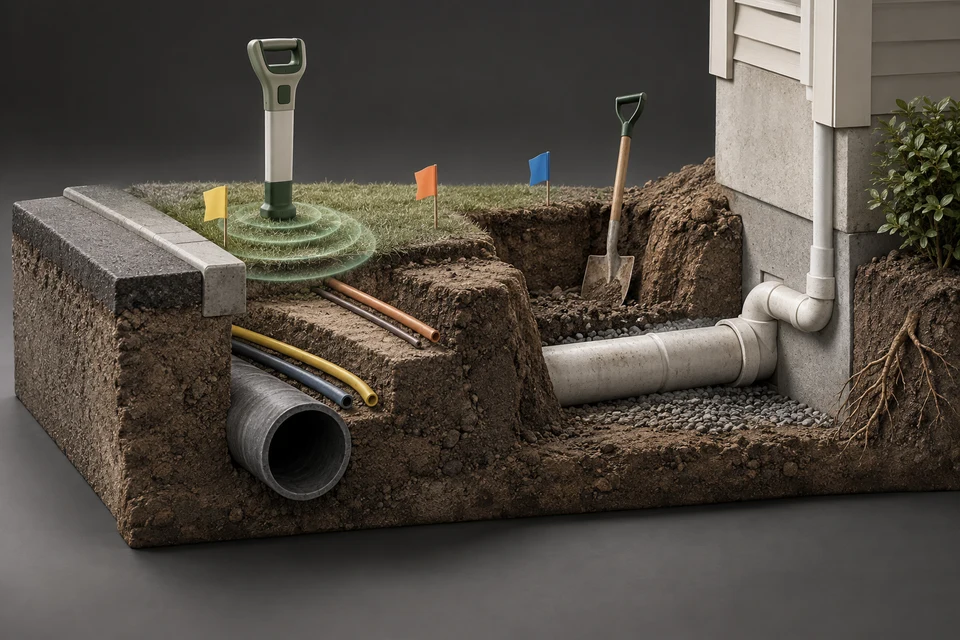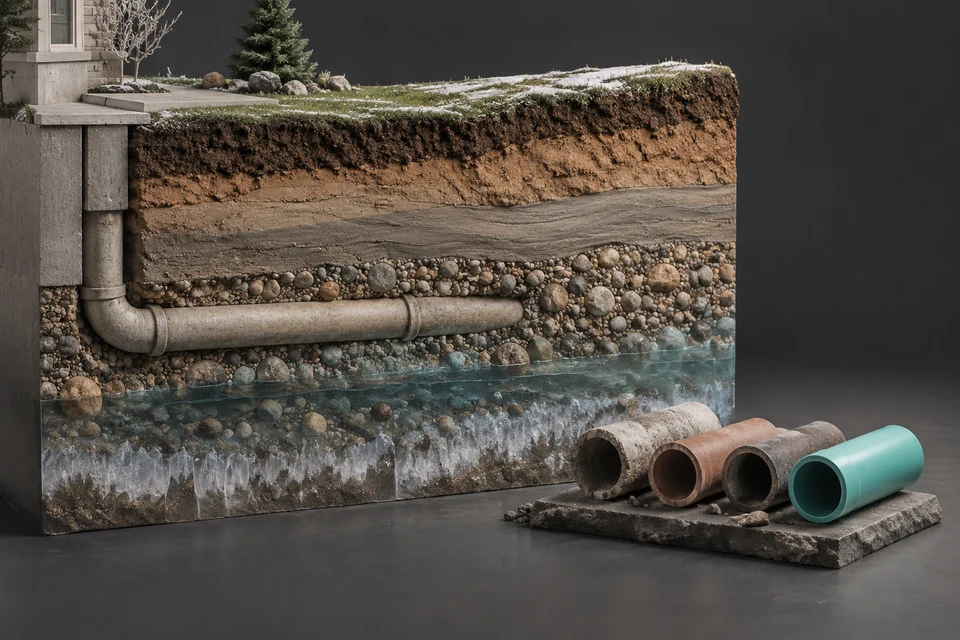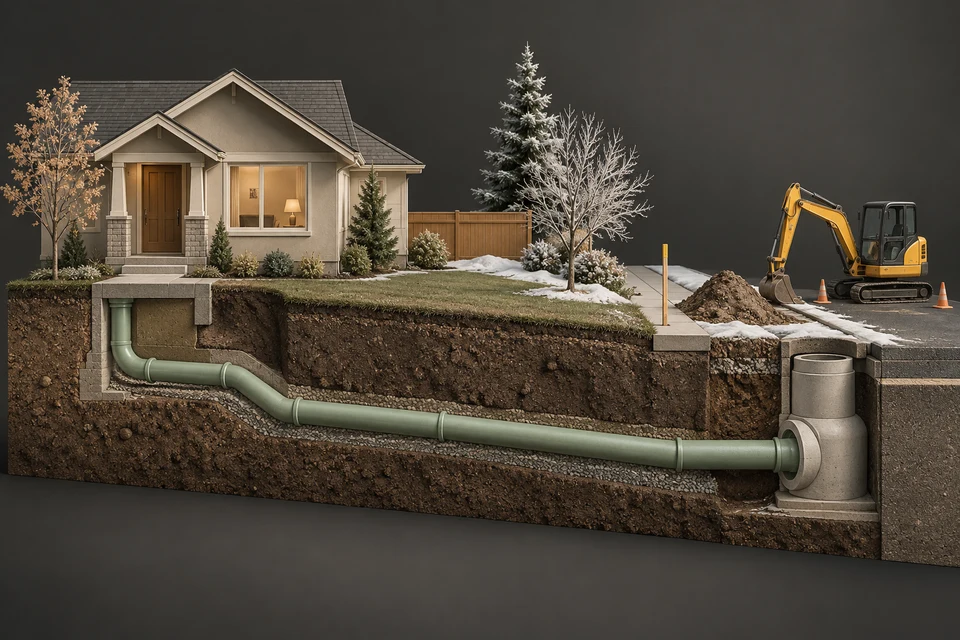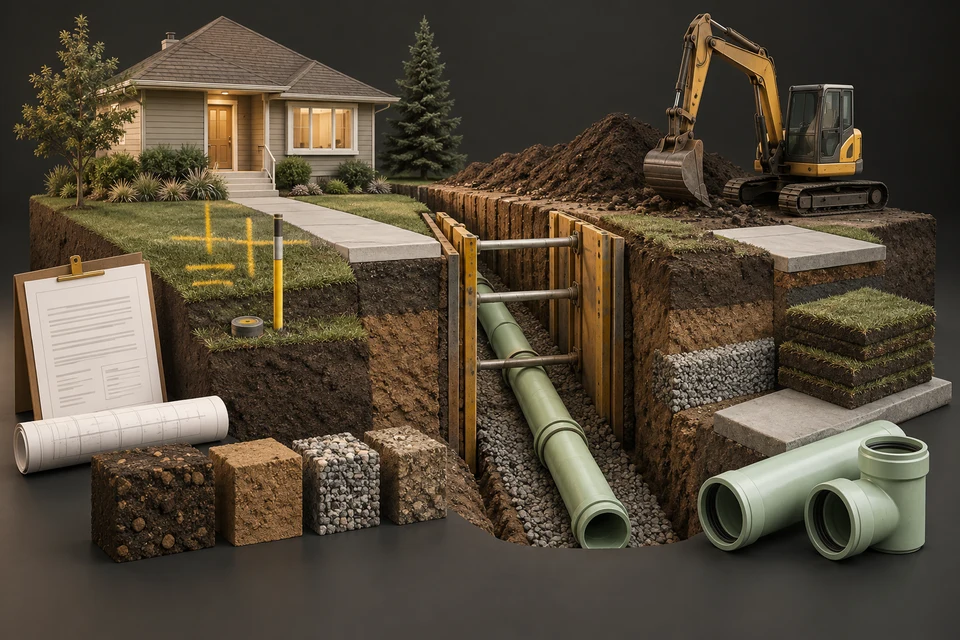
This glossary defines the terms you will meet while replacing a sewer line in Calgary: the permits and City rules, Utility Safety Partners and private locates, Alberta's trench-protection vocabulary, Calgary soil types, the City's pipe material codes, and the words contractors use for bedding, backfill and restoration. Each definition is written for a homeowner reading a quote, a permit or a locate ticket.
- Permit, locate and trench words each come from a different authority: the City, Utility Safety Partners and Alberta's OHS Code.
- The City's material codes describe only the City-owned section of the service line.
- Several terms, such as boulevard and right-of-way, decide whose rules apply to a piece of ground.
01 /How to use this glossary
Terms are listed alphabetically. Where a term comes from a specific rulebook, such as Alberta's Occupational Health and Safety Code or a City of Calgary permit page, the definition says so and the process guides link to the source. Definitions are general information; the City's and the province's current rules govern.
For the terms in context, start with the replacement process step by step, then Calgary plumbing permits, utility locates and soils and depth.
A–ZTerms
- As-built sketch
- A measured drawing of where the new sewer pipe actually runs after installation: distances from the foundation, depths, cleanouts, joints and the property-line connection. It turns future locates into a check rather than a search.
- Backfill
- The soil or granular material placed back into the trench after the pipe passes inspection. It goes in layers, called lifts, each compacted before the next, to limit settlement.
- Backwater valve
- A valve on the building drain with a flap that closes if sewage flows back from the City side. Often added to a replacement scope while floors and drains near the exit point are open.
- Bedding
- The granular material shaped under the pipe so it is supported along its full length at the correct grade. Poor bedding causes dips and point loads.
- Belly (sag)
- A section of pipe that dips below the designed grade and holds water and solids. Lining and bursting follow the existing path, so a belly is usually dug out and relaid.
- Boulevard
- The strip of ground between the property line, sidewalk and curb. In Calgary it is part of the City's road right-of-way, so digging there needs a City excavation permit.
- Building drain
- The lowest horizontal drain inside the house, usually under the basement slab, collecting from the stacks and carrying waste out through the foundation to the building sewer.
- Building sewer (lateral)
- The pipe from the foundation to the City's sanitary main. In Calgary the section from the house to the property line is the owner's, and from the property line to the main is the City's.
- Cast iron (CI)
- A heavy metal pipe used in older homes and in some older City-side service connections. The City's records use the code CI. It corrodes and scales from the inside over decades.
- Change order
- A written, priced change to the agreed work, approved by the owner before the extra work starts. On a sewer job it usually follows a discovery in the trench, such as cobble, deeper pipe or an unmarked line.
- Chinook
- A warm, dry westerly wind that can raise Calgary temperatures sharply in winter. Chinook thaws can soften trench walls and run meltwater into open excavations.
- CIPP (cured-in-place pipe)
- A resin-saturated liner installed inside an existing pipe and hardened in place. In the City's records, CIPP marks relined City sections, usually dated by relining.
- City Qualified Trade (CQT)
- A City of Calgary registration a business needs, together with a contractor business licence, to pull trade permits such as plumbing permits in Calgary.
- Cleanout
- A capped access fitting on the drain or sewer line where cameras and cleaning equipment can enter. Adding one near the foundation or property line is common during a replacement.
- Clearance letter (WCB)
- A letter from WCB-Alberta stating whether a contractor has coverage and whether its account is in good standing. It protects a homeowner from liability for a contractor's unpaid premiums.
- Compaction
- Densifying backfill with a plate compactor or rammer so it does not settle later. Clay-rich soil compacts well only within a band of moisture; frozen soil does not compact.
- Compulsory certification trade
- An Alberta trade whose restricted work must be done by a certified journeyperson, a holder of a recognized certificate, or a registered apprentice under supervision. Plumber is one.
- Concealed plumbing procedure
- The City's process when plumbing was covered without a permit: a licensed contractor must obtain a permit and check the work, and the inspector may ask for it to be exposed.
- Cutting back
- Sloping trench walls to a safe angle instead of, or as well as, installing shoring. Alberta's OHS Code sets the angle by soil class.
- Dewatering
- Pumping water out of a trench or lowering the water around it so crews can work and walls stay stable. Common in wet silt, gravel or during snowmelt.
- Dwelling unit
- In plumbing code terms, a self-contained home under a single tenancy. A City of Calgary advisory notes that a secondary suite counts as a separate dwelling unit, which affects how backflow protection can be arranged.
- Excavation permit
- The City of Calgary permit required to break or dig into the surface of a City road right-of-way, including boulevards, sidewalks, curbs, driveway crossings and lanes.
- Frost ripper
- A single hardened tooth on an excavator used to break frozen ground into chunks at the start of a winter dig.
- Glacial till
- An unsorted mix of clay, silt, sand, gravel and stones left by glaciers. Much of Calgary is built on clay-rich till, which is dense and sticky to dig.
- Grade (slope)
- The steady fall of a sewer pipe toward the main so waste flows by gravity. It is set with a laser or level as the pipe is laid and checked before backfill.
- Ground disturbance
- Under Alberta's OHS Code, work that disturbs or displaces soil, with narrow exceptions such as hand-digging no deeper than 300 mm. Locates are required first.
- Hand expose zone
- The area around a locate mark where machines may not dig until the line is exposed by hand or a non-destructive method. Utility Safety Partners gives one metre either side of the marks for homeowners.
- Haunching
- Material worked in beside the lower sides of the pipe so it is supported around its curve, not only underneath.
- Hoarding permit
- A City permit to occupy space on City-owned right-of-way, such as an alley, sidewalk, boulevard or street, for a construction site.
- Homeowner permit
- A City of Calgary plumbing permit for a legal owner who lives in the home, or intends to, and does the work personally. Not available for apartment-style condominiums.
- Hydrovac
- Excavation with pressurized water and a vacuum truck. It exposes buried utilities without bucket contact and is common in hand expose zones and frozen ground.
- Indemnified contractor
- A contractor on the City of Calgary's approved list under its Master Indemnification Agreement, required for water, sanitary and storm service connections in City rights-of-way.
- Lake sediment (lacustrine)
- Silt and very fine sand deposited in glacial lakes. In Calgary it can stand when dry and run when wet, which matters for trench walls.
- Lift
- One layer of backfill placed and compacted before the next. Thin lifts compact better than a trench filled all at once.
- Locate ticket
- The record of a locate request made through Utility Safety Partners. Utilities' locate documentation states when the locate expires.
- Main (sanitary main)
- The City's sewer pipe in the street or lane that collects from each house's service line. It is City infrastructure; problems there are reported to 311.
- No-drain window
- The hours during a replacement when the old pipe is cut and the new one is not yet connected. Nothing in the house may drain, including toilets, sinks and appliances that empty automatically.
- Normally open backwater valve
- A backwater valve whose flap rests open and closes only when flow reverses. A City of Calgary advisory says one may be used on a building drain or branch serving no more than one dwelling unit.
- Paskapoo Formation
- The sandstone and mudstone bedrock beneath Calgary. It is rarely reached in a residential lateral trench but can lie close to the surface in some areas.
- Pipe bursting
- A trenchless method that breaks the old pipe outward with a bursting head while pulling new pipe in behind, from a launch pit to a receiving pit.
- Private locate
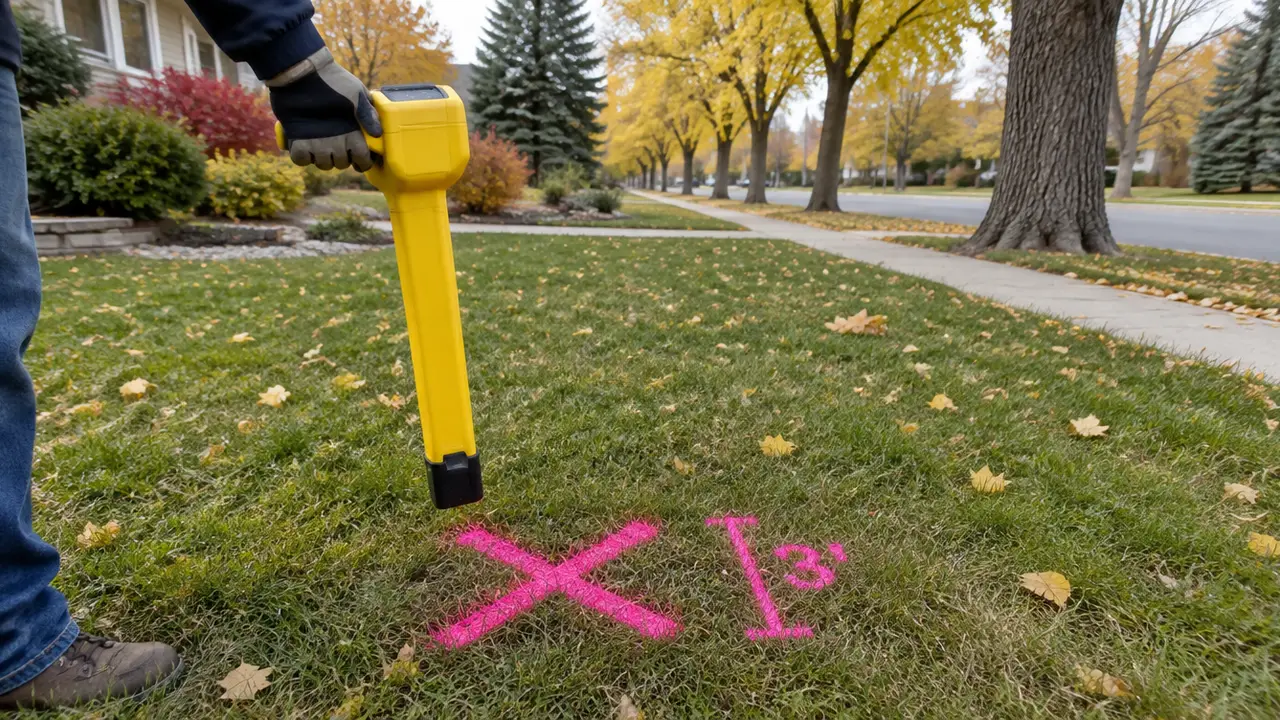
- Locating customer-owned lines that the public locate does not mark, including your sewer lateral, usually with a sonde traced from the surface. Paid for by the owner or included in the contractor's price.
- Property line
- The legal boundary of your lot. The City's published split puts the sewer service from the main to the property line with the City and from the property line to the house with the owner. It is often not at the sidewalk.
- Public-side length
- The metres of sanitary service pipe on City land, from the main to the property line, as recorded in the City of Calgary open data. It says nothing about the private run on the lot.
- PVC
- Polyvinyl chloride pipe, the most common modern material for residential sewer laterals and, in the City's records, for City-side service lines installed from the 1980s on.
- Quick trench program
- A City of Calgary inspection route for new single and semi-detached homes: a qualified contractor installs the water, sewer and storm piping and uploads photos of each trench before backfill.
- Real Property Report
- A survey document prepared by an Alberta Land Surveyor showing a lot's boundaries and improvements. Useful for placing the property line relative to a sewer defect.
- Relocate ticket
- A renewal of a locate request when digging continues past the expiry date on the utilities' locate documentation.
- Restoration
- Putting surfaces back after backfill: topsoil and seed or sod, landscaping, pavers and concrete. In winter it is often temporary until spring.
- Right-of-way (road)
- City land used for streets, sidewalks, curbs, driveway crossings, lanes, walkways and boulevards. Digging in it needs a City excavation permit.
- Safety codes officer
- The City official who reviews and inspects permitted work, including plumbing, for compliance with the codes in force.
- Sanitary Lateral Lining Program
- A City of Calgary program that installs liners inside existing sanitary service pipes to extend their life. Residents' connections are out of service for about three hours during installation.
- Service disconnection
- Taking an existing service out of use, typically before demolition. The City of Calgary requires a water service to be disconnected at the main in some redevelopment timelines, by an indemnified contractor, at the lot owner's expense.
- Settlement
- The gradual sinking of backfill as it consolidates, especially in clay or where frozen soil was used. A settlement top-up visit fixes it.
- Shoring
- Supports installed against trench walls to prevent collapse, such as hydraulic shores, timber bracing or a trench box.
- Sonde
- A small radio transmitter pushed through a pipe on a camera cable so a receiver on the surface can trace the pipe's route and estimate its depth.
- Spoil pile
- The excavated soil set beside a trench. Alberta's OHS Code requires its leading edge to be at least 1 m from the excavation.
- Spot repair
- Excavating one pit to replace a short damaged section of pipe, joined to the existing pipe with couplings at each end.
- Street use permit
- A City permit for exclusive use of a street, sidewalk, alley, walkway, back lane or boulevard, for example for a bin or equipment staging.
- TIL
- The City of Calgary's tile material code in its service line records, generally read as clay tile. It dominates City-side installs of the 1960s and 1970s.
- Transition coupling
- A fitting that joins pipes of different materials or outside diameters, such as new PVC to an old clay or cast iron section.
- Tree protection plan
- A plan the City of Calgary requires when construction happens within six metres of a public tree, reviewed by Parks Urban Forestry.
- Trench box
- A manufactured steel or aluminum box lowered into a trench to protect workers from cave-ins, moved along as work advances.
- Unit rate
- A price agreed in a quote for a measurable extra, such as each additional metre of pipe or half metre of depth, so that surprises on site are priced before the dig rather than after it.
- Utility Safety Partners
- The Alberta organization that takes locate requests and notifies member utilities to mark their buried facilities before ground disturbance.
- VISTA
- The City of Calgary's online system that registered contractors use to apply for trade permits and book inspections.
- Water table
- The level below which the ground is saturated with water. Trenches that reach it, especially in granular soil, need dewatering and stronger wall protection.