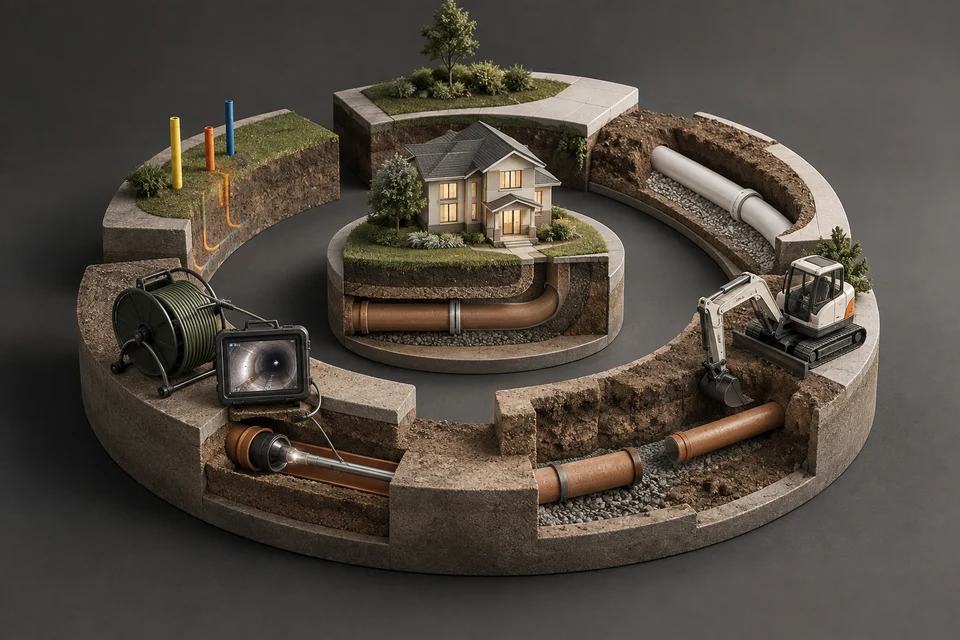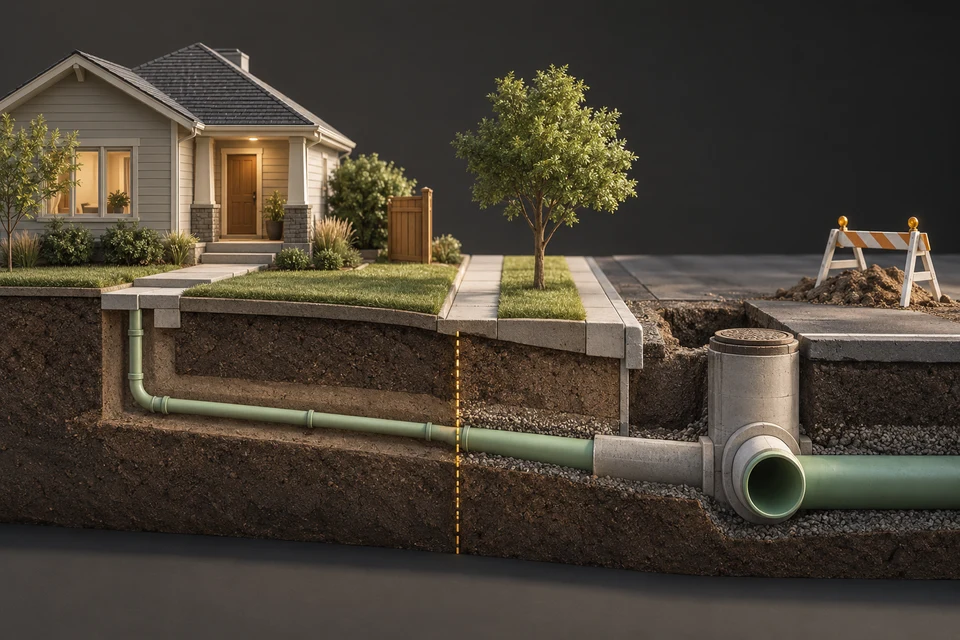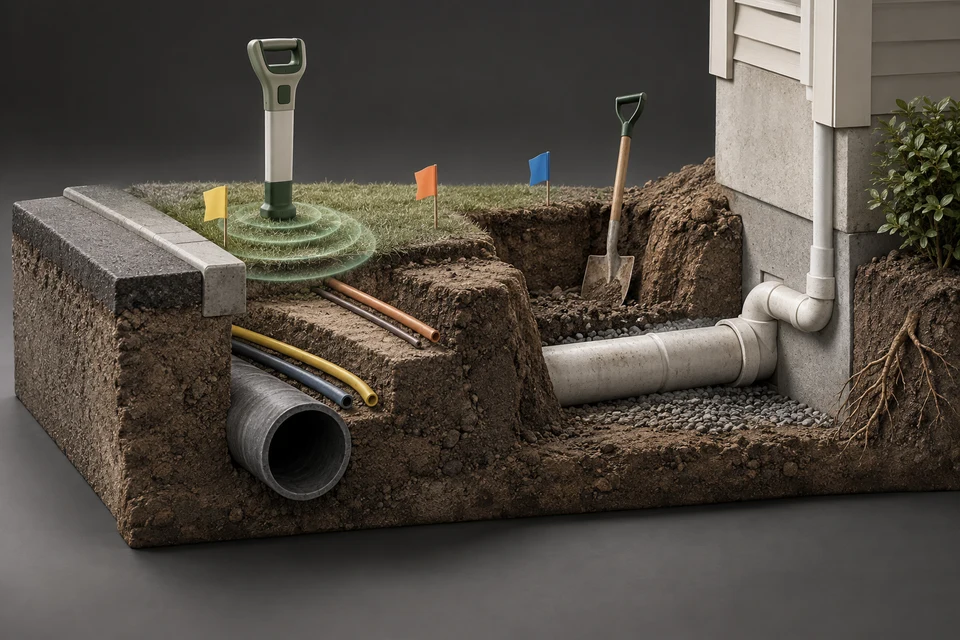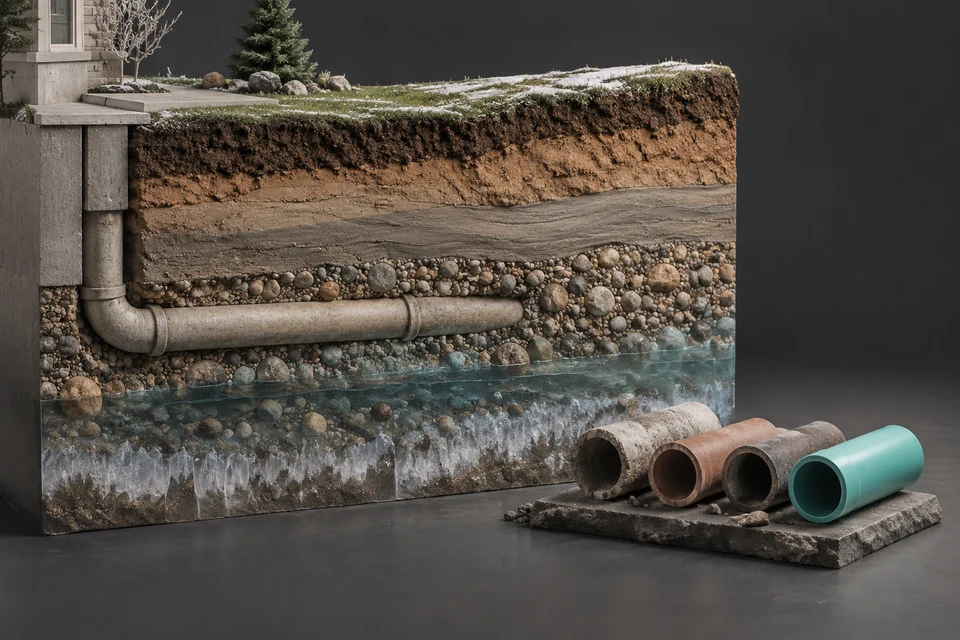
Set the scope of a Calgary sewer repair from the camera footage, not from the symptom. Map every defect to a spot in the yard using footage distances and a sonde trace, mark where the property line falls, then choose spot repair, a partial run or the full private lateral. Write down the metres, method, pipe material, connection points, extras such as a cleanout, and every surface that will be restored.
- A scope is a measured statement: from which point to which point, by which method, in which material, with which surfaces restored.
- Footage-counter distances follow the pipe from the access point; they become yard positions only after a sonde trace on the surface.
- The City's records cover only its own section, main to property line; your private section can be a different material and age.
- In 1960s–1970s Calgary communities the City records show mostly clay tile on the public side, a strong hint about what the private side started as.
- Open ground is the cheapest moment to add a cleanout or other access; decide before the trench is dug, not after.
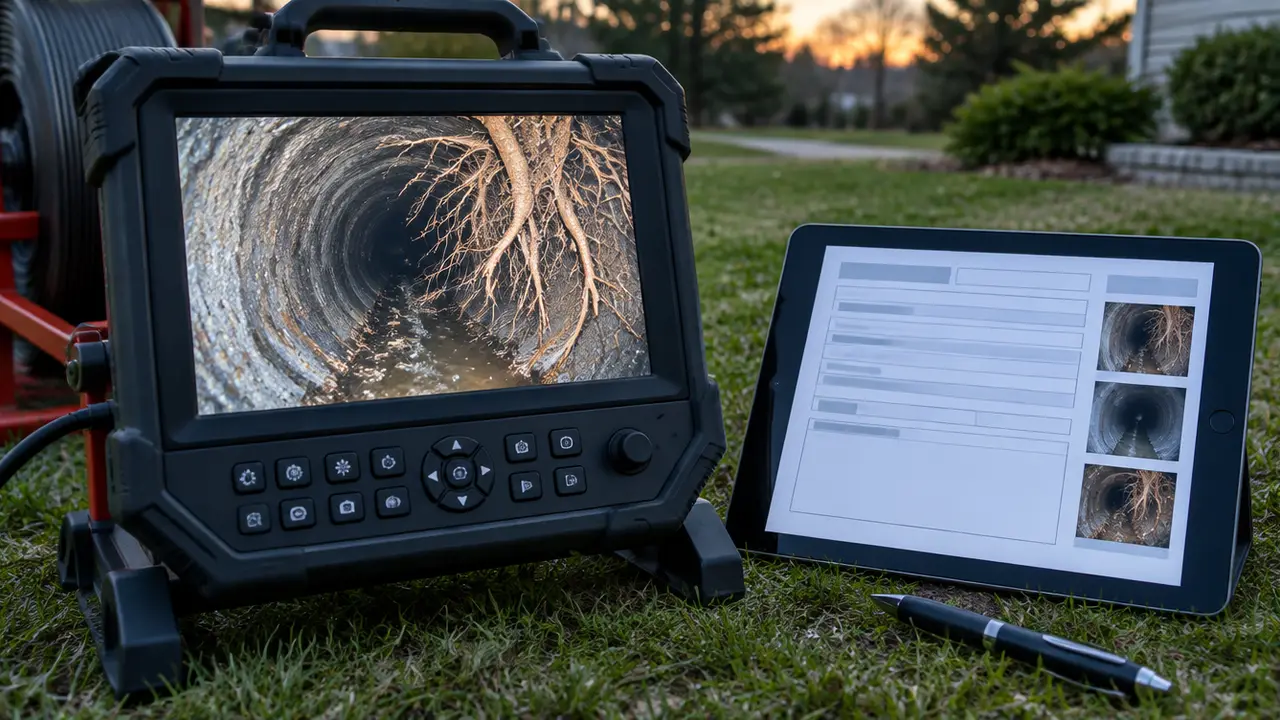
01 /What does the scope of a sewer job mean in Calgary?
The scope is the written boundary of the job: the exact length of pipe being repaired or replaced, where that length starts and stops, the method, the new material, how it connects at each end, and what gets put back on the surface afterwards. Two contractors quoting “replace the sewer line” can be pricing jobs that differ by ten metres, a driveway and a property-line connection. A written scope is what makes their prices comparable and what the permit and inspection are measured against.
A usable scope statement fits in five lines. For example: replace 14.5 m of private lateral from the inside cleanout to 0.3 m short of the property line; open cut; new 100 mm PVC sewer pipe on granular bedding; rubber transition couplings at both ends; restore lawn with topsoil and seed, and relay the existing paving-stone walk. Anything a contractor cannot express in that form is not yet a scope.
02 /How do you turn camera footage into a scope?
Footage becomes a scope in three steps: log each defect with its counter distance, trace the pipe on the surface with a sonde, then translate each counter distance into a marked point in the yard. The counter measures cable paid out along the pipe from the access point, so it follows every bend and drop. A defect at 11.0 m on the counter is not 11 m from the foundation in a straight line if the pipe dog-legs around a tree or drops under a step.
- Ask for the video file and a written log listing each observation with its counter distance and clock position.
- Have the operator park the camera head at each significant defect and mark the surface above it using the sonde, with a depth reading.
- Mark the property line on the ground. A Real Property Report from your purchase, survey pins, or the City's property information can show where it is; the sidewalk edge is often not the line. Finding where your sewer line runs shows how the City's record marks where its section meets that line.
- Measure from the foundation wall to each mark and to the property line, and sketch it on a plan of the lot.
- Note what sits on the surface over each mark: lawn, tree, walk, driveway, deck or garage pad.
With that sketch, the scope nearly writes itself. You can see whether the defects cluster, whether any sit near or past the property line, and which surfaces a trench would cross. Utility locates for a Calgary sewer dig covers the sonde trace in more detail.
03 /Spot repair, partial run or full lateral: which fits the defects?
The pattern of defects along the line decides the scope more than any single defect does. One cracked joint in otherwise sound pipe supports a spot repair. Defects at several joints spread along the run usually mean the pipe is failing as a system and a partial fix only moves the next backup down the line.
| What the footage shows | Usual scope | Process consequence in Calgary |
|---|---|---|
| One defect, sound pipe either side | Spot repair of one section | One pit, one permit, one inspection; quick restoration |
| Defects at two or three joints close together | Partial replacement of that run | A short trench; confirm couplings to the old pipe at each end |
| Roots or offsets at most joints of clay pipe | Full private lateral | Full-length trench or a trenchless method; longer locate area |
| A belly holding water over several metres | Replace the sagging length at least | Lining follows the bad grade, so a dig is usually involved |
| Collapse or pipe the camera cannot pass | Replace at least to sound pipe | Excavation at the collapse; the rest assessed once the camera can pass |
| Defect at or past the property line | Stop the private scope at the line | Report to 311 with footage before any dig there |
If you want a second opinion on whether the pattern calls for repair, lining or replacement, SewerReplacement.ca runs the national decision logic method by method. This page is about turning that decision into a Calgary job someone can permit, dig and inspect.
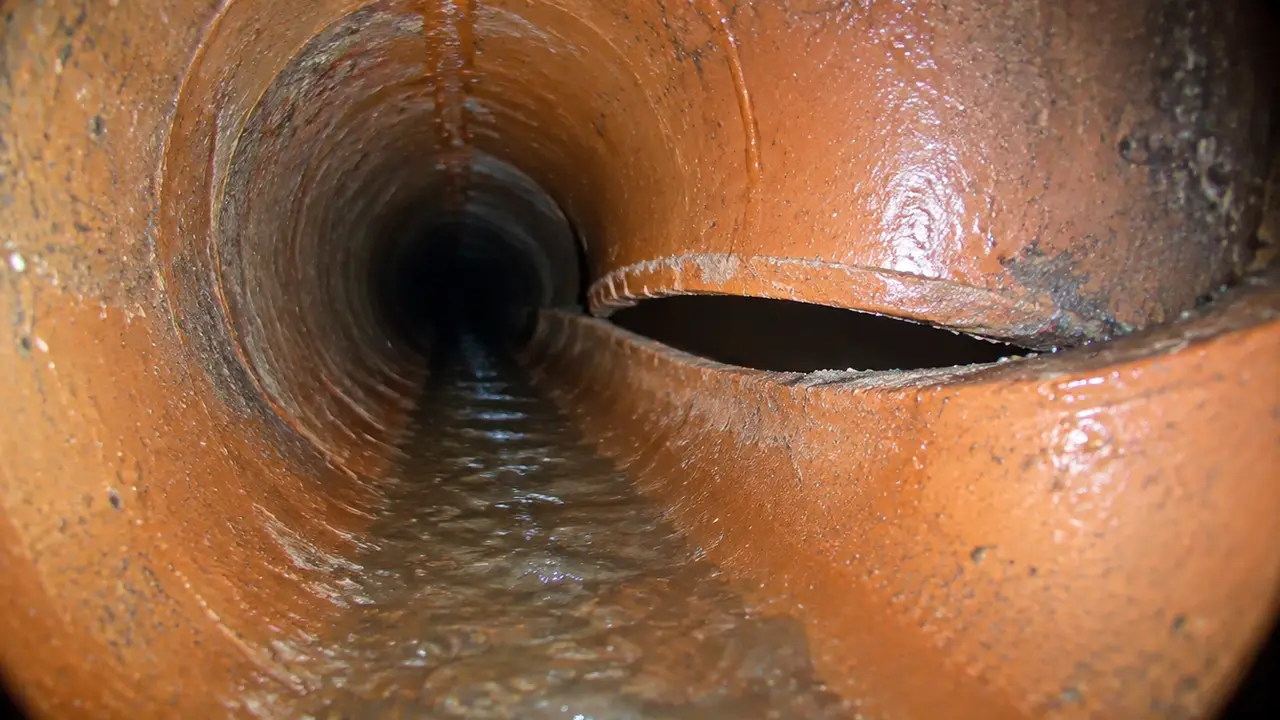
04 /What does your community's era say about the pipe you will find?
Your community's development era is a strong clue to what the original lateral was made of, and the City's own records show the pattern clearly. A HAUSE analysis of the City of Calgary's Public Sanitary Service Lines dataset groups 367,397 City-owned service lines by the City's community structure classification. Those records cover only the section from the main to the property line. The private section on your lot can be a different material and may have been replaced at a different time.
| Structure class | Service lines | % TIL (generally clay tile) | % cast iron | % PVC | % relined (CIPP) |
|---|---|---|---|---|---|
| 1950s | 46,833 | 23.1 | 18.5 | 22.7 | 3.8 |
| 1960s/1970s | 71,348 | 77.5 | 0.3 | 17.4 | 1.7 |
| Inner City | 23,906 | 0.1 | 11.7 | 41.6 | 3.9 |
| 1980s/1990s | 70,484 | 9.1 | 0.0 | 87.6 | 0.2 |
| 2000s | 73,482 | 2.1 | 0.0 | 95.7 | 0.0 |
The practical reading for scoping: in communities such as Maple Ridge, Rundle, Marlborough Park and Willow Park, more than 95 percent of City-side records carry the TIL code. In Rosscarrock, St. Andrews Heights and Spruce Cliff, cast iron makes up roughly half of the City-side records. In Highwood, Glendale and University Heights, about a fifth of City-side lines are already coded CIPP, meaning the City has relined its section and the record date is the relining date. None of this tells you the condition of your private pipe, but it tells you what to expect at the property line, where your new pipe will have to join the City's.
CalgarySewers.ca maps these records community by community, and the soils and depth page connects them to what a trench in each era of neighbourhood usually meets.
05 /Should the scope stop at the property line?
For a private contractor, yes: the scope normally ends at or just inside your property line, because the City's published position is that it owns and maintains the section from there to the main. The practical question is what happens at the joint. Your new pipe has to connect to whatever the City section is, which may be clay, cast iron, PVC or a liner, often at a slightly different outside diameter.
- Ask what coupling will join new to old at the property-line end, and whether it suits the City-side material shown in the records or on camera.
- Ask how close to the line the trench will go. Digging right to the boundary can put the excavation edge into the boulevard, which is City right-of-way with its own permits.
- If the camera shows the City section is defective, call 311 with the footage before you finalize your scope. Replacing only your side and reconnecting to a failing City section can leave the problem in place.
- Record the connection. A photo of the property-line joint before backfill, with a tape in the frame, is one of the most useful documents you will own.
The permits, contractors and timing for anything past the line are covered in working on the City side.
06 /What should ride along while the ground is open?
Additions are cheapest when they are in the first scope, because the excavation, locates, permit and restoration are already paid for. Once the trench is backfilled, each of these becomes its own job.
| Add-on | Why now | Question for the contractor |
|---|---|---|
| Exterior cleanout near the foundation | Gives future camera and cleaning access without pulling a toilet | Where will it surface, and how will it be protected from frost and mowers? |
| Cleanout near the property line | Lets a camera reach the City connection directly | Will a riser here conflict with the boulevard or trees? |
| Replacing the building drain under the slab | An old cast iron or clay section indoors can fail next | Is the indoor section in the footage and in the permit? See under-slab replacement |
| Backwater valve on the building drain | Floors and drains are already being opened near the exit point | Does the plan keep the valve accessible for maintenance? |
| Tracer wire or marker tape over the new pipe | Makes future locates easier on a non-metallic pipe | Will it be included on the as-built sketch? |
When your scope is written, the Permit & Locate Checklist starts with it as item one, and you can request quotes with the sketch and footage attached.
FAQQuestions people ask
Is a sewer line repair in Calgary treated differently from a replacement?
The City lists replacing sewer lines as permit work, while repairing a leak in a drainage system and removing a blockage are listed as not needing a plumbing permit. Where a spot repair replaces a length of pipe, confirm with the City whether a permit applies before work starts.
How do I find where my property line actually is?
A Real Property Report, survey pins or City property information show it. The sidewalk or curb is often not the line, and in many Calgary blocks the boulevard between them is City right-of-way.
Can the scope include the City's section if I pay for it?
Not by simply adding it to a private quote. The City owns and maintains the main-to-property-line section, and work in its right-of-way needs City permits and, for service connections, contractors on the City's approved list. Start with 311.
Should I replace the whole lateral if only one joint is bad?
Not necessarily. One defect in otherwise sound pipe supports a spot repair. If the footage shows problems at many joints or the pipe is clay or old cast iron throughout, a full private replacement is usually the more durable scope.
What if my footage does not reach the main?
Then part of the line is unknown, and the scope should say so. Ask for another run from a different access point, or plan to camera the remaining length once the trench opens.
NETWORKGo deeper across the HAUSE Sewer network
Renting a sewer camera and scoping your own line
Can you rent a sewer inspection camera and scope your own line? What rental and consumer cameras do, how to use one safely, and where DIY falls short.
SewerRoots.caRoots in the main sewer line: is it your lateral or the city's sewer main?
Roots in the main sewer line: how to tell your own lateral from the city sewer main, clues that point to the public side, and who to call first.
SewerQuotes.comSewer line replacement cost: open-cut vs trenchless, line by line
Sewer line replacement cost in Canada for 2026: open-cut, CIPP lining and pipe bursting planning ranges in CAD, per-metre math, line items and what moves price.