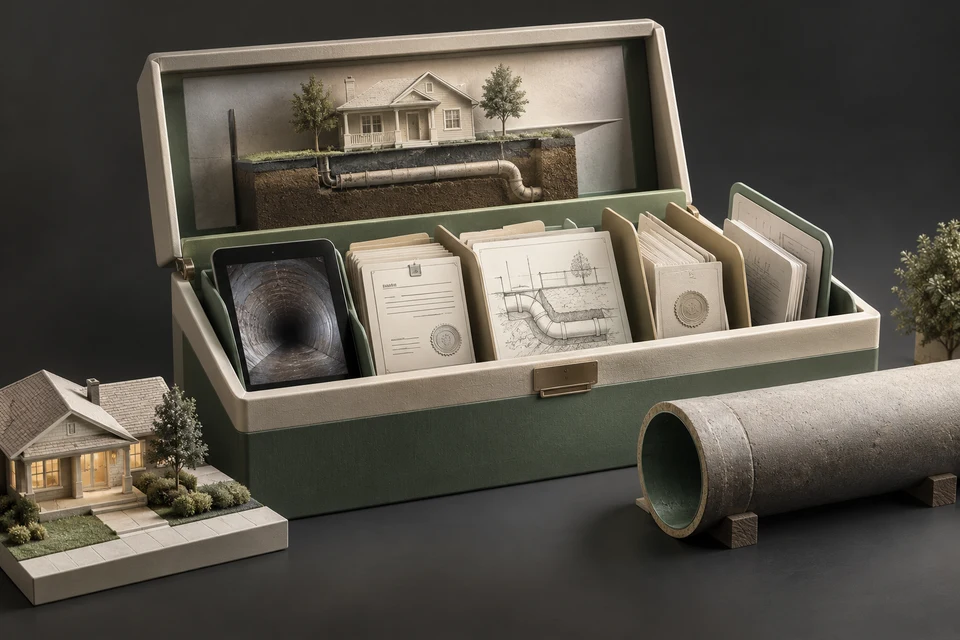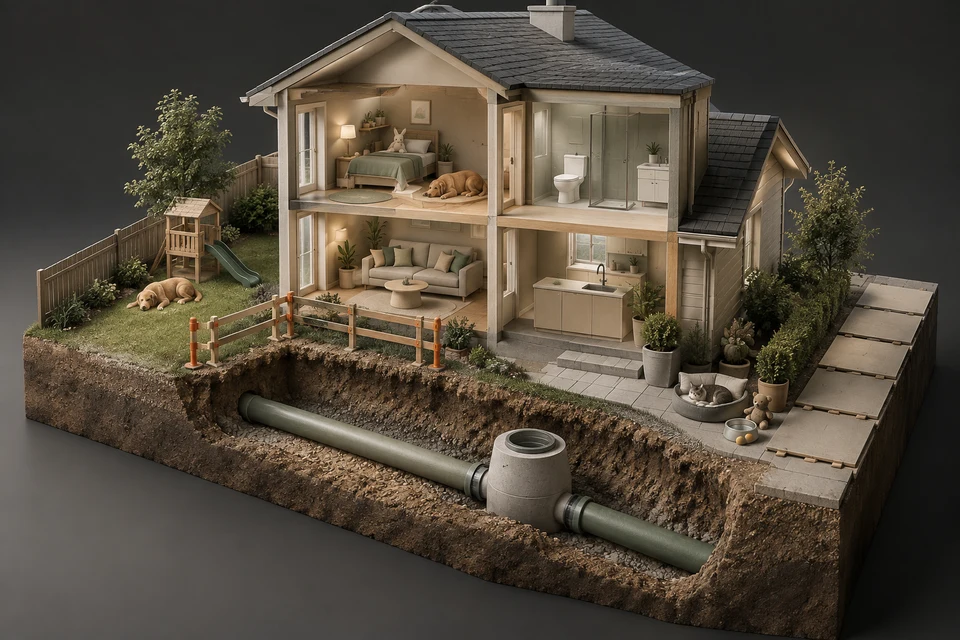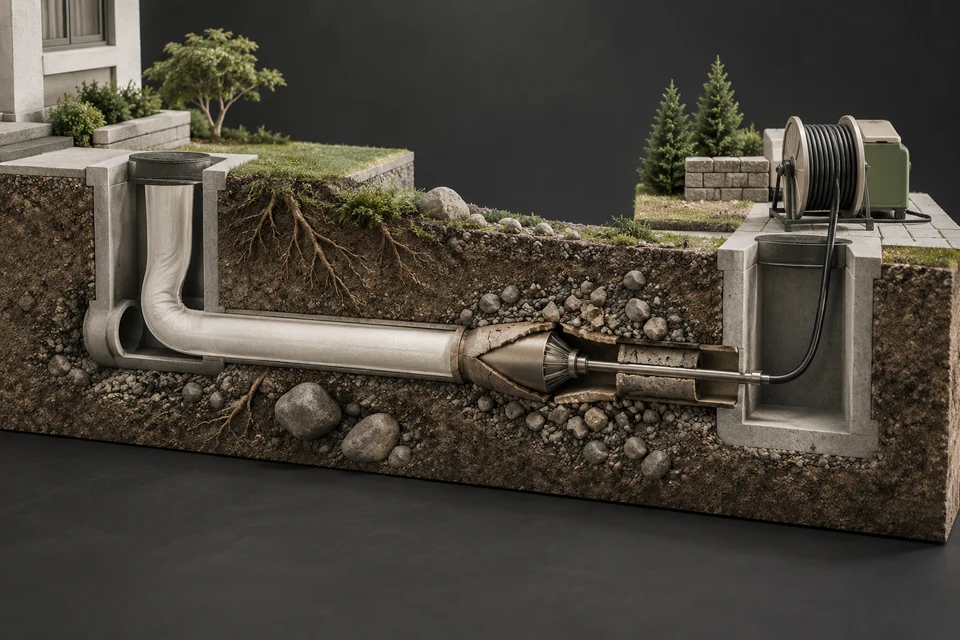
Trenchless replacement in Calgary means either lining the old lateral with a resin liner cured in place, usually a one-day job from a cleanout or small pit, or bursting it and pulling new pipe through, usually one to two days with a pit at each end and at each connection. Both still need locates for any pit and a camera before and after. Sags, collapses, tight bends and cobble can rule one or both out.
- Trenchless does not mean no digging: bursting needs pits, and lining may need an access pit where no usable cleanout exists.
- A lining day is cleaning, camera, wet-out, inversion, curing, reinstating connections and a final camera.
- Bursting follows the old pipe's path, so it cannot fix a sag, and it struggles with tight bends and cobble.
- Every pit is a ground disturbance that needs public locates and a private locate like any trench.
- The City relines many of its own service sections; its records show those as CIPP, which matters for where your work meets it.
01 /What does trenchless mean for a Calgary lateral?
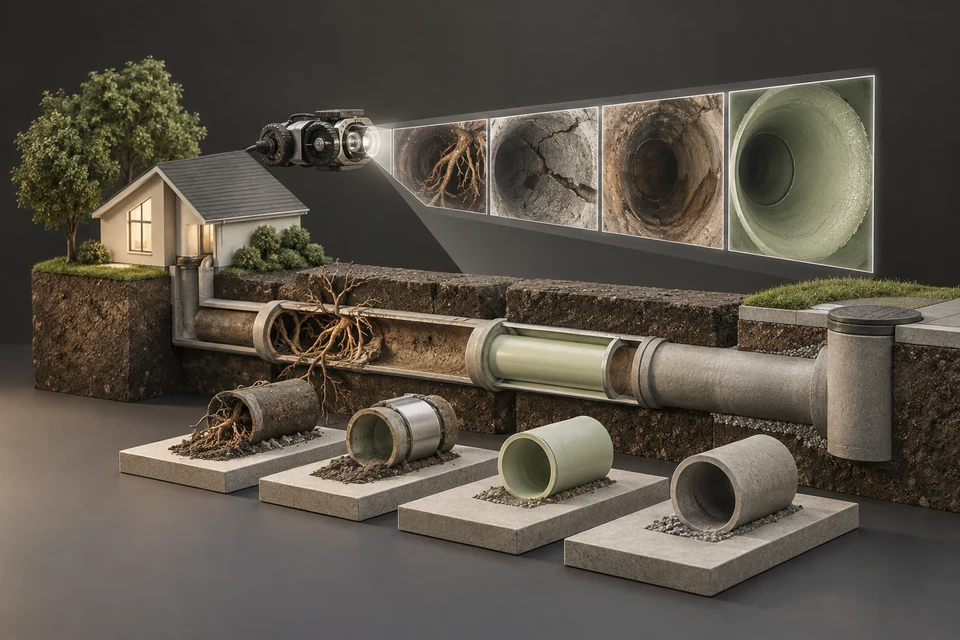
Trenchless covers two families of method on a residential lateral. Lining, usually cured-in-place pipe or CIPP, puts a new pipe inside the old one. Pipe bursting breaks the old pipe outward and pulls a new pipe into the space it leaves. Both avoid a trench along the whole length, which on a Calgary lot usually means saving a driveway, a mature tree or a finished landscape.
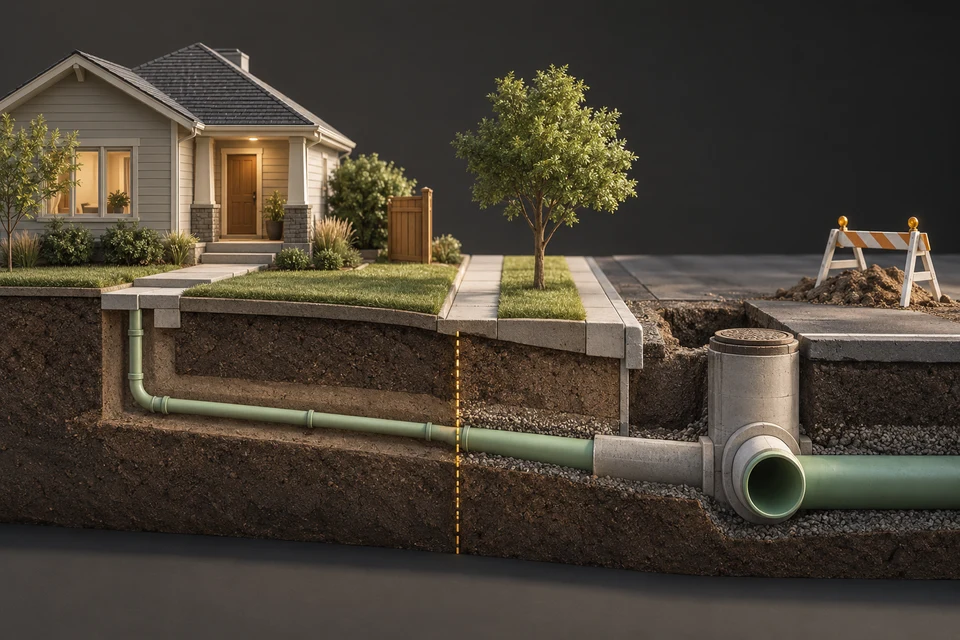
Neither method is dig-free. Bursting needs a launch pit and a receiving pit, plus an excavation at every connection along the line. Lining works from an existing cleanout when one gives straight enough access; otherwise the crew opens a small pit to create one. Each of those holes is a ground disturbance, with the same locate requirements, hand-expose zones and, if deeper than 1.5 m, the same trench-protection rules as an open cut.
The choice between lining, bursting and digging is an engineering decision for your line; SewerReplacement.ca compares them method by method. This page follows what each looks like in a Calgary yard.
02 /What happens on a lining day?
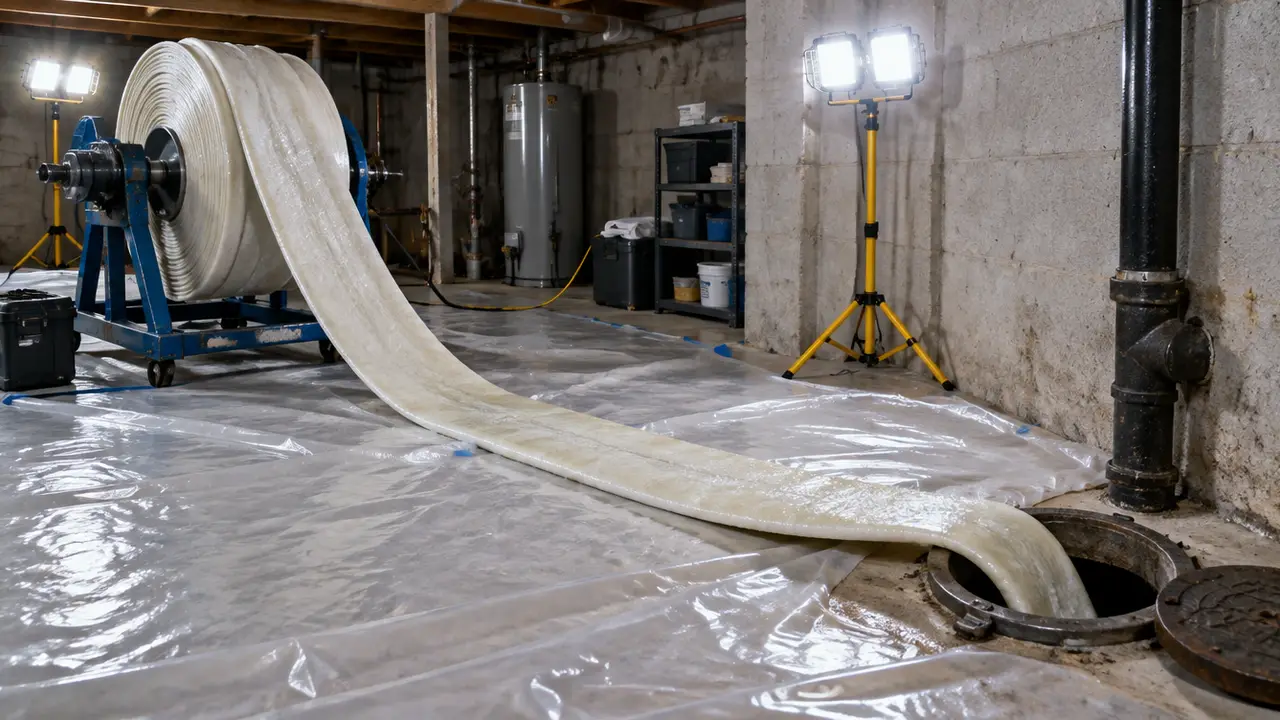
A lining job is usually one day on site, and much of it happens at a truck parked at the curb, with hoses running to the access point. The house has no drain from cleaning until the liner is cured and the ends are opened, often several hours.
- Clean the host pipe
Jetting, and descaling for cast iron, removes roots, scale and debris so the liner can bond and sit smoothly.
- Camera and measure
A camera run confirms the pipe is clean and passable, locates connections and measures the exact length to line.
- Wet out the liner
The felt or fibreglass tube is saturated with resin at the truck, to the measured length.
- Install the liner
The liner is inverted or pulled into the host pipe and pressed against the wall with air or water pressure, often with a bladder.
- Cure
The resin hardens in place, by ambient cure, hot water, steam or light depending on the system. Cold weather lengthens ambient cures.
- Open the ends and reinstate
The liner ends are trimmed, and any side connections are reopened with a remote cutter.
- Final camera
A recorded run shows the lined pipe, the ends and every reinstated connection.
The City's own lining program gives a sense of the disruption on the public side: its Sanitary Lateral Lining Program page says a resident's sewer connection is out of service for about three hours while a City crew installs a liner. A private job may run longer because it includes the cleaning and camera work at the start.
03 /What happens on a bursting day?
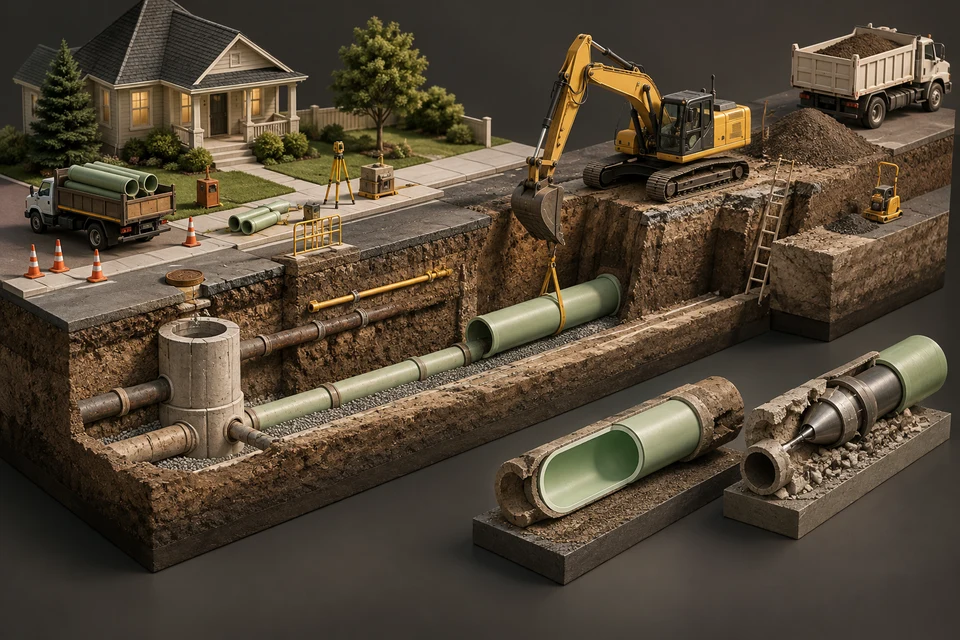
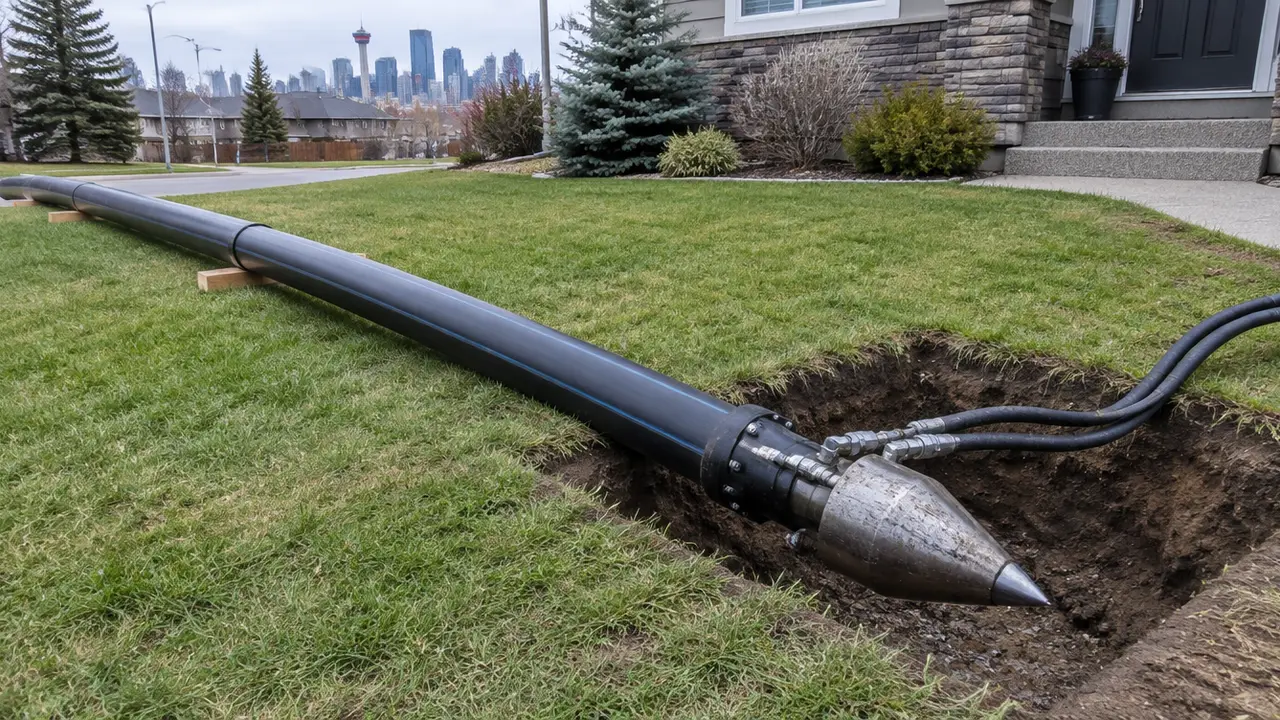
A bursting job usually takes one to two days: the first part digging and protecting the pits, the second pulling the new pipe and making connections. In a typical residential layout, one pit is near the foundation and the other near the property line.
- Excavate the launch and receiving pits, and a pit at any connection along the line. Pits deeper than 1.5 m are shored or sloped like any trench.
- Thread a cable or rods through the old pipe from one pit to the other.
- Join lengths of new pipe, commonly high-density polyethylene joined by heat fusion, into one continuous string on the surface.
- Attach the bursting head, which is larger than the old pipe, with the new pipe behind it.
- Pull the head through with a winch or hydraulic unit; the old pipe fractures outward and the new pipe follows.
- Connect the new pipe at each pit with transition couplings, then camera the full length.
04 /When do Calgary conditions rule trenchless out?
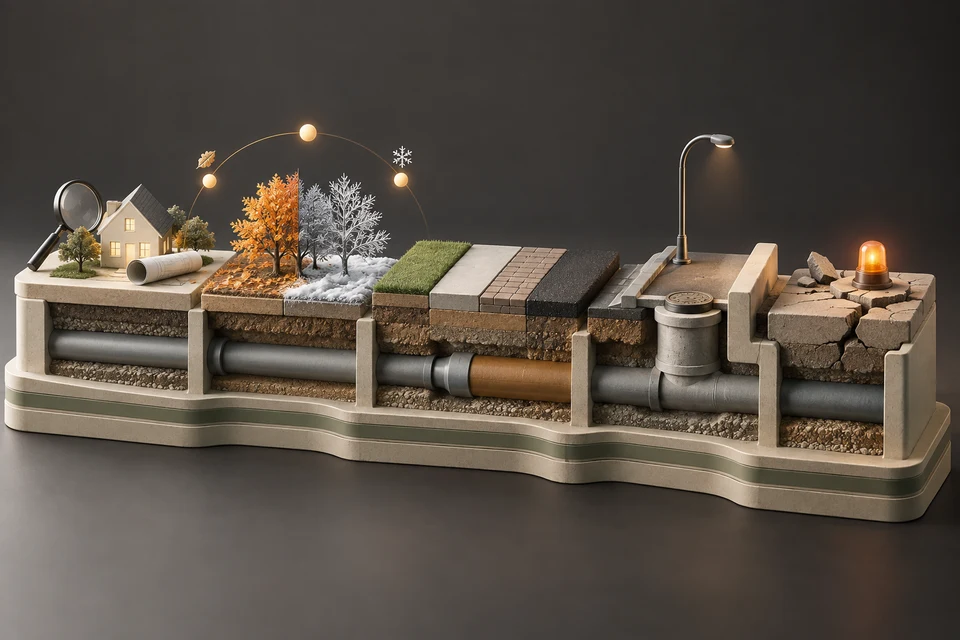
Calgary ground and Calgary pipe each produce a few predictable problems. The Alberta Geological Survey's description of the Calgary urban area, with quartzite gravel or hard sandstone under thin till or lake sediment in many places, is a reminder that what surrounds the pipe matters as much as the pipe.
| Condition | Lining | Bursting |
|---|---|---|
| Sag or belly | Follows the bad grade; the belly remains | Follows the old path; the belly remains |
| Collapse | Cannot pass a collapse; dig first | Possible only if a cable can pass |
| Two or more tight bends | Possible, with care at bends | Generally not suitable |
| Undersized pipe | Reduces the bore slightly | Can upsize in suitable ground |
| Cobble or boulders around the pipe | Little effect | Can stall the head or deflect the new pipe |
| Shallow line near other services | Little effect | Heave risk; expose nearby services |
| Side connections along the line | Reinstated from inside | An excavation at each |
If the camera shows a belly, the realistic answer is often a hybrid: dig and relay the sagging length, and line or burst the rest. The scope guide shows how to turn footage into that kind of split.
05 /What permits and inspections apply to trenchless work in Calgary?
Treat trenchless replacement as permit work until the City tells you otherwise. The City lists replacing water and sewer lines in or around the home as plumbing permit work; whether a specific lining job falls inside that is a question for the City's plumbing safety codes officers through 311, answered before the work, and noted with the date.
- Locates apply to every pit and to any excavation for an access point, with a private locate for the lateral route itself.
- Inspection of a lined or burst pipe relies heavily on the recorded camera run, because most of the new pipe cannot be seen from the surface. Ask how the inspector will verify it, and keep both the before and after video.
- City-side work is separate. If the job would push a liner or a bursting head past your property line, the City's permits and rules for its right-of-way apply; see working on the City side.
06 /What if the City has already relined its section?
Then your private work meets a liner at the property line, not the original pipe. The City's public service line records code relined City sections as CIPP, with the relining date on the record. In a HAUSE analysis of those records, 4,113 City-side service lines carry the CIPP code, most of them relined since 2010. They are concentrated in older communities such as Highwood, Glendale, University Heights, Rosemont and Crescent Heights, where between about 16 and 22 percent of City-side records are CIPP. Those records describe only the City-owned section; your private side may still be original clay or cast iron.
Share the City record with your contractor before they plan the property-line end. A private liner that stops short of the line, or a burst pipe that joins at a pit inside your lot, keeps your work on your side and makes the joint with the City's section something both can inspect. For planning ranges on how long a lining or bursting job takes from quotes to records, use the Replacement Timeline Planner, then request quotes from firms that offer the method your footage supports.
FAQQuestions people ask
Is trenchless sewer replacement available in Calgary?
Yes. Both lining and pipe bursting are used on Calgary laterals. Whether your line qualifies depends on its condition on camera, its bends and connections, and the ground around it.
How long does trenchless lining take?
Usually about a day on site, with the house drain out of service for several hours during cleaning, installation and curing.
Does trenchless mean no digging at all?
No. Bursting needs pits at each end and at connections, and lining needs an access point, which is sometimes a small pit.
Can a liner fix a sagging sewer line?
No. A liner follows the existing grade, so a belly remains. The sagging section usually has to be dug and relaid.
Do I still need locates for trenchless work?
Yes, for every pit or access excavation. The lateral route itself also needs a private locate.
NETWORKGo deeper across the HAUSE Sewer network
Pipe bursting cost: trenchless sewer line replacement, priced
Pipe bursting cost in Canada (2026): trenchless sewer replacement ranges in CAD, pit and per-metre pricing, upsizing, and when it beats lining or digging.
SewerRoots.caPermanent fixes for roots in sewer lines
Permanent fixes for roots in sewer lines: CIPP lining, sectional point repairs, pipe bursting and open-cut replacement compared by cost, lifespan and fit.
SewerJetting.caHydro jetting weeping tile: how foundation drains are cleaned, and when they cannot be
Hydro jetting weeping tile explained: how foundation drains clog with silt, roots and iron ochre, how they are jetted from the sump, and when to replace them.