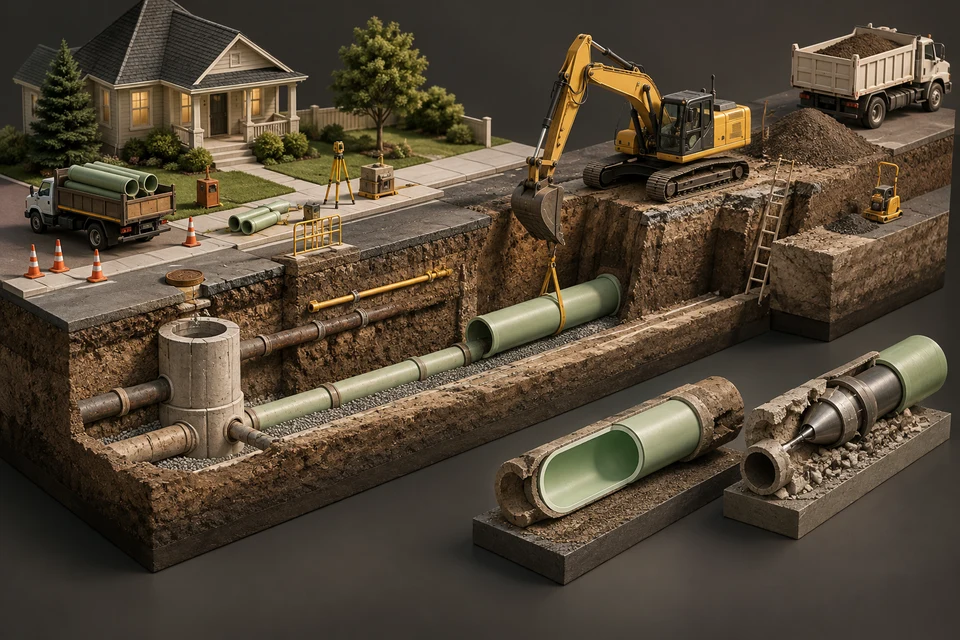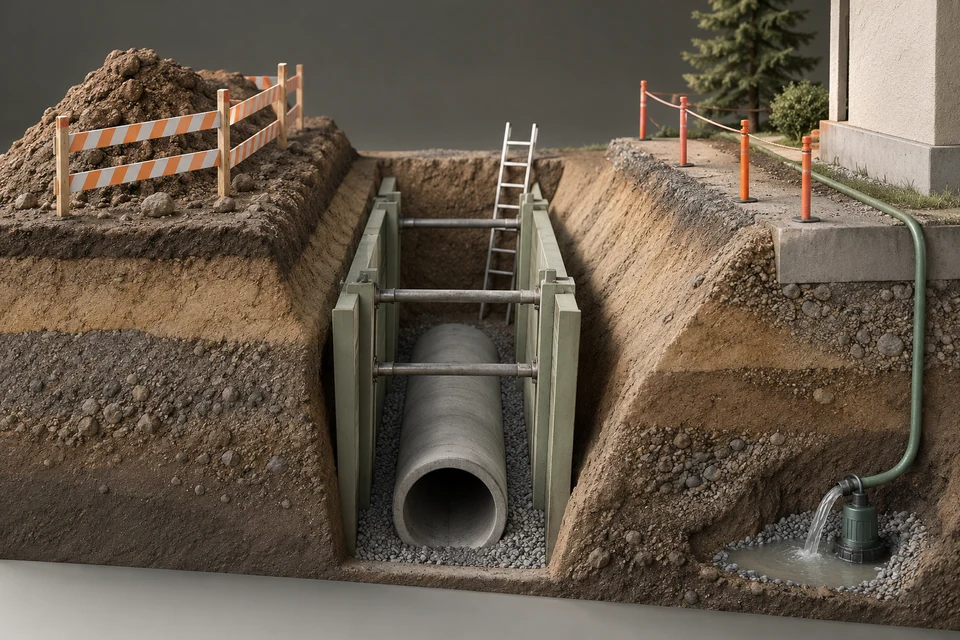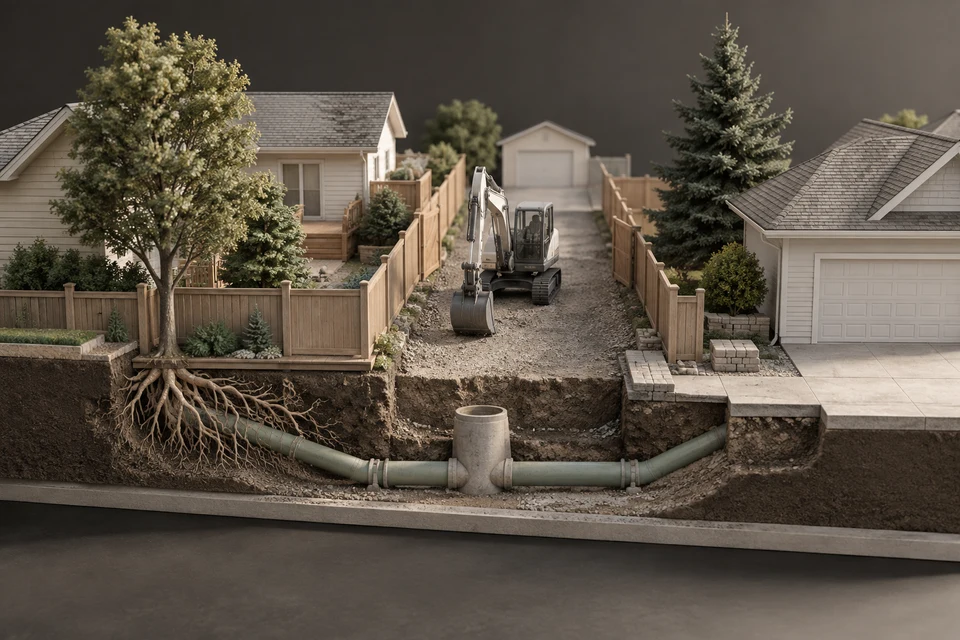
A Calgary sewer replacement often touches neighbours: the machine may need their side yard or a shared driveway, the lane or street may be needed for a bin, their trees may root into your line, and some older or semi-detached homes share a lateral. Talk to neighbours early, get any access or shared-line arrangement in writing, photograph their side before work, and confirm City permits for any lane, sidewalk or boulevard use.
- Narrow lots can mean the only machine access is across a neighbour's yard or a shared driveway; that needs their written agreement.
- Exclusive use of a street, sidewalk, lane or boulevard for a bin or equipment needs a City street use permit.
- A lateral shared with a neighbour, or one that crosses their lot, turns a private job into a two-owner job; find out on camera before scoping.
- Photographs of neighbouring foundations, fences and lawns before work protect everyone.
- A short written notice to neighbours with dates, hours and a contact heads off most complaints.
01 /Why does a sewer replacement involve the neighbours?
Because a sewer job rarely stays inside one lot's working space. The excavator has to get to the front or back yard, the spoil and trench box need room, a disposal bin needs somewhere to sit, and the line itself may run close to, under or across a shared boundary. On older Calgary lots with narrow side yards, a detached garage on the lane and mature trees on both sides of the fence, the neighbours' cooperation can decide which method is practical.
It is also a matter of impact. For one to three days, the neighbours live beside a machine, a truck or two, and an open trench. Most people are generous when told ahead of time and irritated when surprised.
02 /How does the crew get equipment to the trench?
Access is one of the first things a contractor checks on a site visit, and the answer shapes the method and the price. A compact excavator needs a clear path somewhat wider than its tracks; a hydrovac truck and a dump truck need to park within hose and loading reach.
| Situation | Typical solution | What to arrange |
|---|---|---|
| Front-yard lateral, open frontage | Machine enters over the lawn or driveway on mats | Vehicles moved; street parking for trucks |
| Narrow side yard, backyard access needed | Smaller machine, or remove a fence panel | Neighbour's agreement if their side is used |
| Shared driveway | Machine and trucks use the drive during work hours | Written agreement on access times and repair of any damage |
| Lane access to a rear lateral or garage | Machine and bin in the lane | A City street use permit for exclusive use of the lane |
| No machine access at all | Hand digging, a vacuum excavator, or a trenchless method | Method discussion with the contractor |
If a disposal bin, materials or equipment will occupy a street, sidewalk, alley, walkway, back lane or boulevard, the City's street use permit page says a permit is required, with minimum review periods of 5, 10 or 15 business days depending on the impact. Build that into the schedule; City-side work covers the related permits.
03 /What if your lateral is shared or crosses a neighbour's lot?
Then the job has two owners, and nothing should be dug until both know it. Shared laterals turn up in older semi-detached pairs, some older infill conversions, and occasional older layouts where one house's line crosses the next lot to reach the main. The camera is how you find out: a second branch joining your line before the property line, or a route that heads toward the fence rather than the street, are the usual clues.
- Confirm the layout with a camera run from each house and a sonde trace on the surface.
- Check for a written arrangement. Some shared lines are covered by registered easements or agreements; many older ones are not. A real estate lawyer can search title and advise on what exists.
- Agree scope and cost sharing in writing before work starts, including who hires the contractor and who holds the permit.
- Condominium townhouses are governed by the condominium corporation; the City's homeowner permit rules require board authorization for owner-done work in individually owned condo townhouses.
- Ask 311 if the shared section connects to the City side in an unusual way; the City's records show only its own portion.
04 /What about the neighbour's trees, fence and foundation?
A trench along a shared boundary can affect whatever stands on the other side of it. Deal with each before work starts, not when the bucket reaches it.
- Trees: roots from a neighbour's tree often cause the root intrusion that prompted the replacement. Cutting large roots near their tree can harm it, so discuss the route and ask the contractor how roots will be handled. If it is a City tree on the boulevard, the City's six-metre tree protection plan rule applies.
- Fences: agree which panels come down, who stores them and who reinstalls them. Photograph the fence first.
- Foundations: on narrow lots a deep trench can come close to a neighbour's foundation. Alberta's OHS Code requires engineered temporary support for a foundation that may be affected by an excavation, before the excavation starts; ask the contractor how close the trench will be.
- Their buried lines: a neighbour's gas service, garage feed or sprinkler line can cross near the boundary. Private lines on their lot are not marked by the public locate, so ask them what they know and let the private locator check.
For planting and root questions after the job, SewerRoots.ca covers which trees and distances cause the most trouble.
05 /How should you tell the neighbours?
A short written note a week ahead does most of the work. Deliver it by hand if you can, and give the contractor's site contact as well as your own.
- What
Replacing the sewer line from the house to the property line, with a small excavator and a trench across the front yard.
- When
Planned dates and daily working hours, with a note that weather or inspection can move them by a day.
- What they will notice
Machine noise, a truck parked on the street, a fenced trench overnight, a bin if one is needed.
- What you need from them
Any access you have agreed, such as a fence panel or the shared drive, and a request to keep children and pets back from the fencing.
- Who to call
Your number and the contractor's site lead.
Tell the neighbours about anything that affects their street parking, their side of a shared driveway or their view of the site at night, such as fencing or a lit barricade. If the work will run into a second or third day because of an inspection or a cold snap, a quick update the evening before is appreciated far more than an apology after the fact.
On semi-detached homes, add one line about water: if a shared section is being worked on, both households may lose their drain for part of a day. Coordinate the shutdown window together.
06 /What should be documented about neighbouring property?
Photograph the neighbour's side before work starts, with their agreement: foundation walls facing the work, fences, lawn and landscaping along the boundary, the shared driveway and the sidewalk in front of both houses. Date the photos. Do the same at handover. If a question comes up later about a crack or a sunken strip, dated photos settle it quickly and keep the relationship intact.
Keep any access agreement, shared-line agreement and the notice you delivered with the job records. The Permit & Locate Checklist includes notifying neighbours when access or shared lines are involved, and keeping sewer replacement records covers where those documents belong. When access is sorted, request quotes and tell each contractor what you have arranged.
FAQQuestions people ask
Do I need my neighbour's permission to replace my sewer line?
Not for work entirely on your own lot. You do need their agreement to use their land, a shared driveway or a shared line, and you should tell them about work that will affect them.
Can a bin sit on the street or in the lane during the work?
The City requires a street use permit for exclusive use of a street, sidewalk, lane or boulevard. Ask your contractor or bin supplier who applies.
My neighbour's tree roots damaged my sewer line. Who pays?
That depends on the facts and any agreements, and it is a legal question. Practically, a new jointless or tightly jointed line resists roots far better than old clay.
How can I tell whether my lateral is shared with the house next door?
A camera run and sonde trace show whether another branch joins your line before the property line, or whether your route crosses a neighbouring lot.
Will the work damage my neighbour's foundation?
A properly planned and protected trench should not. On narrow lots, ask how close the trench will be and whether engineered support is required.
NETWORKGo deeper across the HAUSE Sewer network
Sewer line replacement cost: open-cut vs trenchless, line by line
Sewer line replacement cost in Canada for 2026: open-cut, CIPP lining and pipe bursting planning ranges in CAD, per-metre math, line items and what moves price.
SewerCleaners.caWhere is my backwater valve? How to find it, recognize it and open the cover
Where is the backwater valve in a house? How to find it, what it looks like, what access box, sleeve and cover mean, how to open it safely, and valve alarms.
SewerRoots.caRoots in the main sewer line: is it your lateral or the city's sewer main?
Roots in the main sewer line: how to tell your own lateral from the city sewer main, clues that point to the public side, and who to call first.