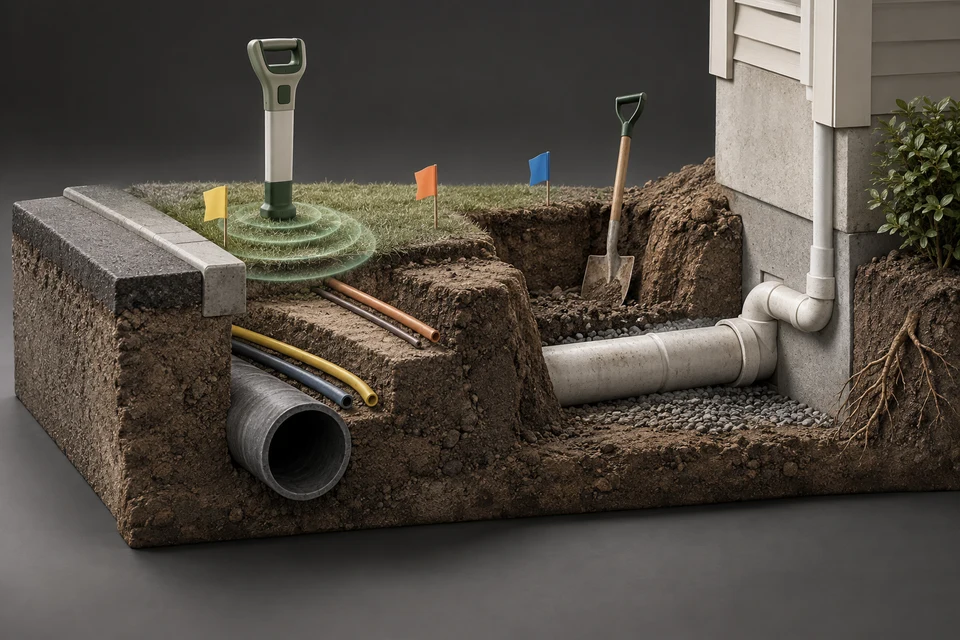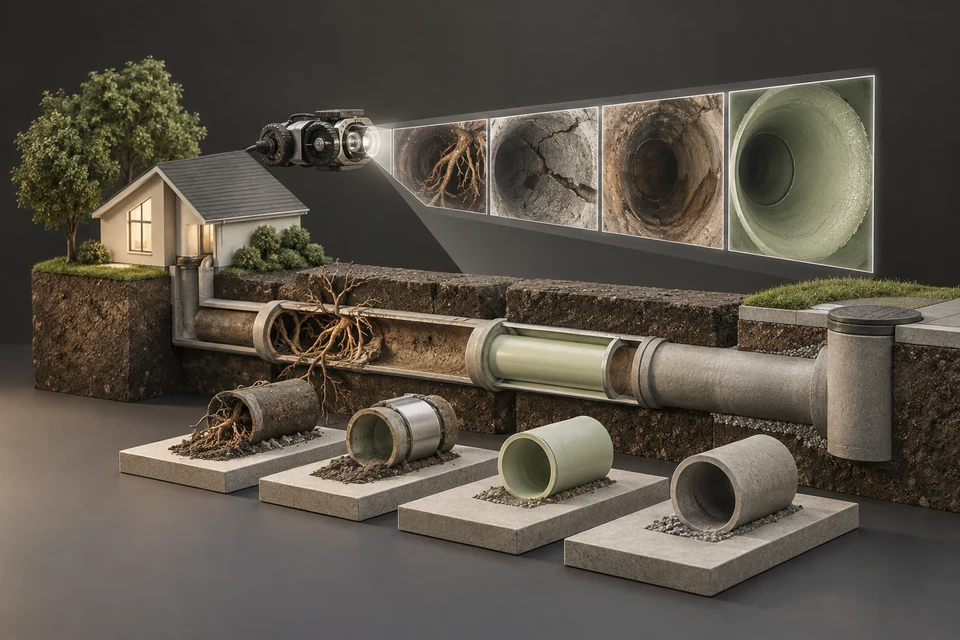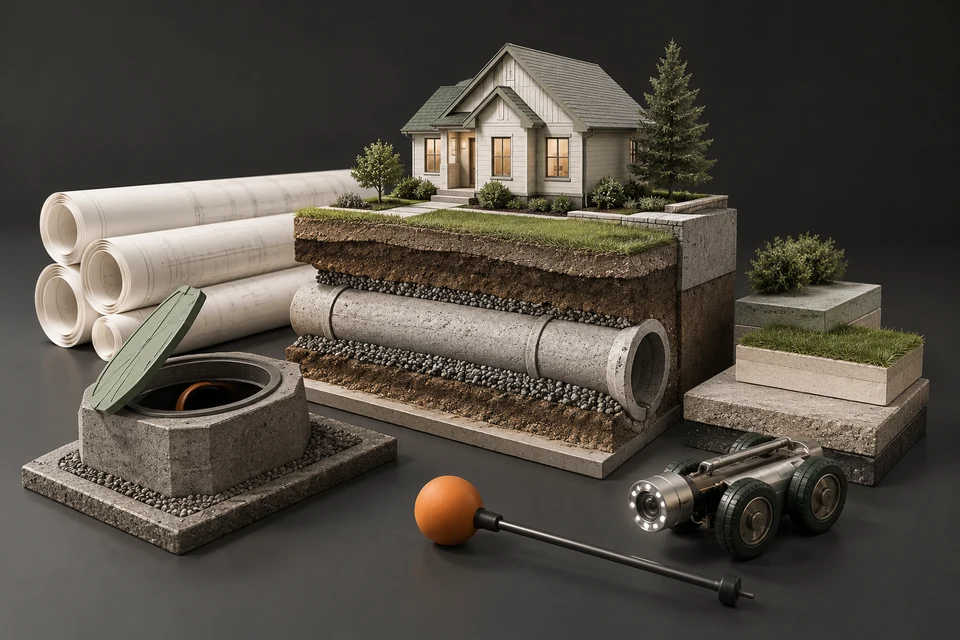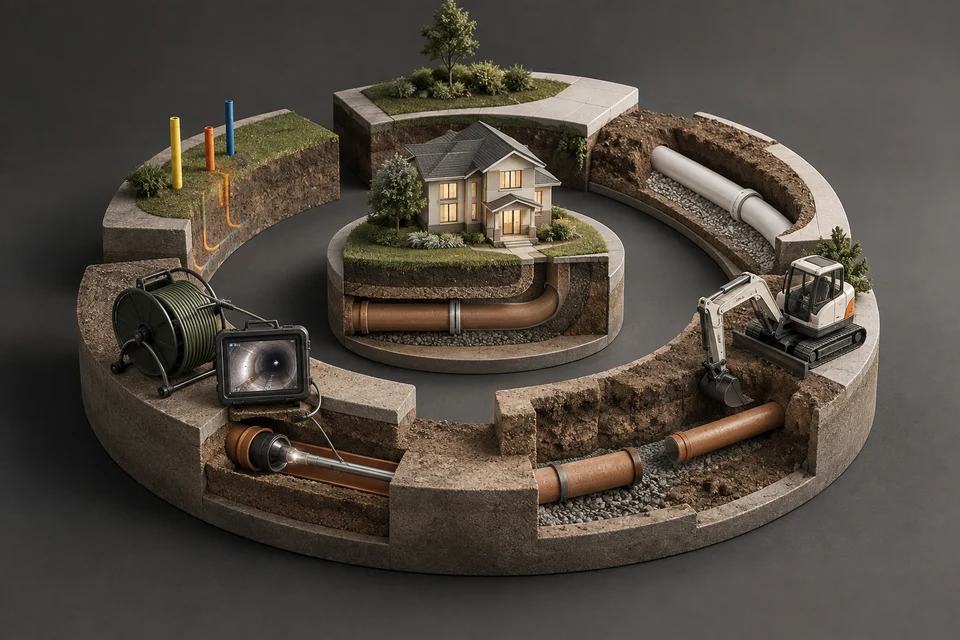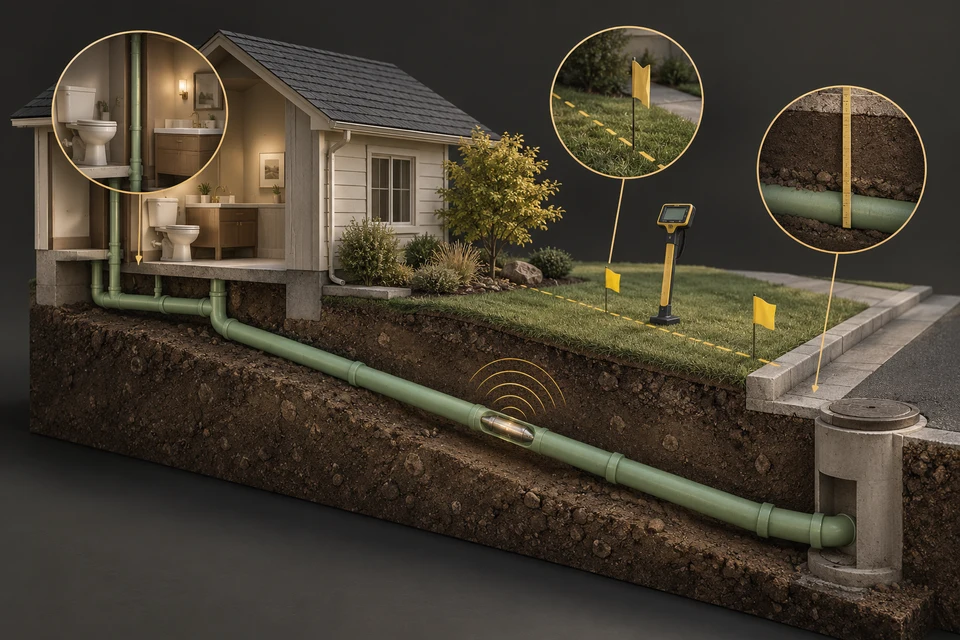
To find where your sewer line runs in Calgary, start indoors at the main cleanout and note which foundation wall the building drain heads toward. Then look up your address in the City's Public Sanitary Service Lines data, mapping the City's short section from the main to your property line. Join those two points, check yard clues, and confirm the route with a camera and sonde trace before anyone digs.
- The route is anchored at two ends you can find without digging: where the drain leaves the house and where the City's section meets your property line.
- The City's open data maps only its own section; for single-family homes that public piece averages about 8 metres, and the private run on your lot is not shown.
- Yard clues such as a sunken strip or an old cleanout cap suggest a route but never replace a sonde trace.
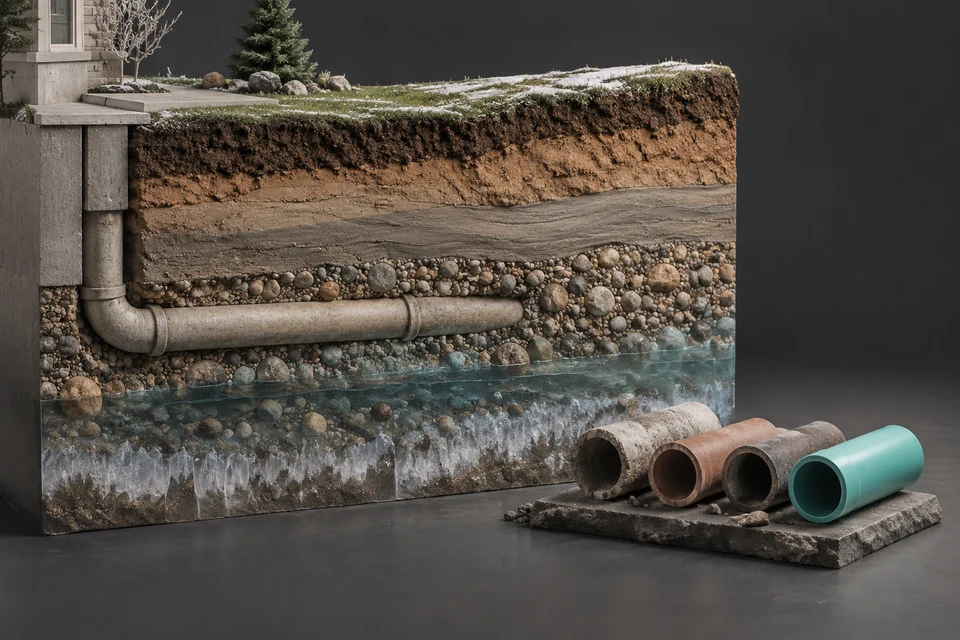
- Locate marks show approximate position, not depth; Calgary's minimum cover for a new sanitary service is 4.5 ft, and basement-home laterals usually sit far deeper.
- Write the route down with measurements once it is found, because the paint disappears within weeks.
01 /Where does a Calgary sewer line usually run?
In most Calgary houses the sewer line leaves under the basement floor, passes through or beneath the foundation wall on the side facing the City's sanitary main, and runs in a fairly direct line to the property line. From there the City's section continues to the main. On many lots that means a line toward the street; in some communities the main sits in the back lane instead, so the direction is not something to assume from the front door.
Straight is the plan, not a promise. Lines were bent around trees, dog-legged past a garage slab, or rerouted during an earlier repair. A replacement scope drawn on the assumption of a straight run can miss a turn by a metre or more, which matters when a trench has to stay clear of a gas service or a neighbour's fence.
02 /What can you learn from inside the house?
Quite a lot, and it costs nothing. The basement shows the first fixed point of the route: the spot where the building drain exits the foundation. Walk the basement with a tape measure and a notepad before calling anyone.
- Find the main cleanout
Usually a capped fitting on or near the floor at the base of the main stack, or a round plate in the slab. The pipe running away from it points toward the exit wall.
- Follow the stack down
The largest vertical pipe in the house, often in the furnace room or behind a basement bathroom wall, drops into the building drain under the floor.
- Note the floor drain and any old patches
A rectangular concrete patch in the slab often marks earlier drain work, and it can show the drain's path under the floor.
- Measure to the exit wall
Record the distance from the cleanout to the inside face of the foundation wall the drain heads toward. That number later separates the indoor pipe from the outdoor lateral on camera footage.
- Look outside at that wall
An exterior cleanout riser, a patched section of parging, or a depression beside the foundation often sits right over the exit point.
If the building drain is finished over with flooring and walls, the camera footage is the only way to see where it goes. Replacing the building drain under a basement floor covers what happens when the problem turns out to be inside the foundation rather than in the yard.
03 /What does the City's sewer service line map show?
It shows the second fixed point. The City of Calgary publishes a Public Sanitary Service Lines dataset on its open data portal that you can search by address. Each record describes the City-owned piece of your service, from the sanitary main to the property line, with a mapped line whose property-line end marks roughly where your private pipe begins.
| Field | What it holds | How it helps you |
|---|---|---|
| Address and street | The address the service serves | Confirms you are reading your own record, not the neighbour's |
| Service line geometry | A mapped line for the City section | Its property-line end approximates where your lateral crosses the line; its main end shows street or lane |
| Public-side length | Metres of pipe on City land | Tells you how far the main is past your property line |
| Material | City codes such as PVC, CI, TIL, CIPP | Shows what your new pipe must join at the property line |
| Diameter | Pipe size in millimetres | Tells the contractor which coupling to bring |
| Installed date | Date on the City record | For CIPP records it is usually the relining date, not the original install |
A HAUSE query of that dataset in September 2026 found 316,197 active single-family service records with an average public-side length of about 8.0 m, and 346,717 of the 367,397 active records listed at 100 mm. In practical terms, most Calgary homeowners can expect the City piece to be short and standard-sized, with most of the route on their own lot.
Reading the codes and dates in depth is the specialty of CalgarySewers.ca, which maps the City records community by community. For tracing a route, you only need the geometry's property-line end and the side of the lot where the main sits.
04 /What clues on the lot point to the route?
With the exit wall and the property-line crossing roughly known, the yard often fills in the middle. Walk the line between the two points and look for anything that suggests old digging. Treat every clue as a hypothesis for the camera to test.
| Clue | What it may mean | Trust level |
|---|---|---|
| A long shallow dip or sunken strip | Old trench backfill that kept settling | Moderate: could also be an old water service or a buried feed |
| A stripe of greener or browner grass in summer | Different soil or moisture over old fill | Low to moderate; irrigation lines leave the same pattern |
| An exterior cleanout cap in the lawn | Direct access to the lateral at that point | High for that spot; the pipe runs through it |
| A concrete patch in the driveway or walk | An earlier repair dug through the slab | Moderate; ask the previous owner or check old invoices |
| A water shut-off lid near the property line | Where the water service crosses | Low for the sewer; on older lots the two often run near each other but not always together |
| An old Real Property Report or permit drawings | Building position and sometimes service notes | Good for the property line; rarely shows the sewer itself |
Previous owners, the home inspection report from your purchase, and old invoices are underused sources. A sewer file from an earlier repair often includes the footage length to a defect, which tells you exactly how far out the pipe was opened last time. Keeping sewer replacement records lists what a complete file holds.
05 /When do you need a camera and sonde trace?
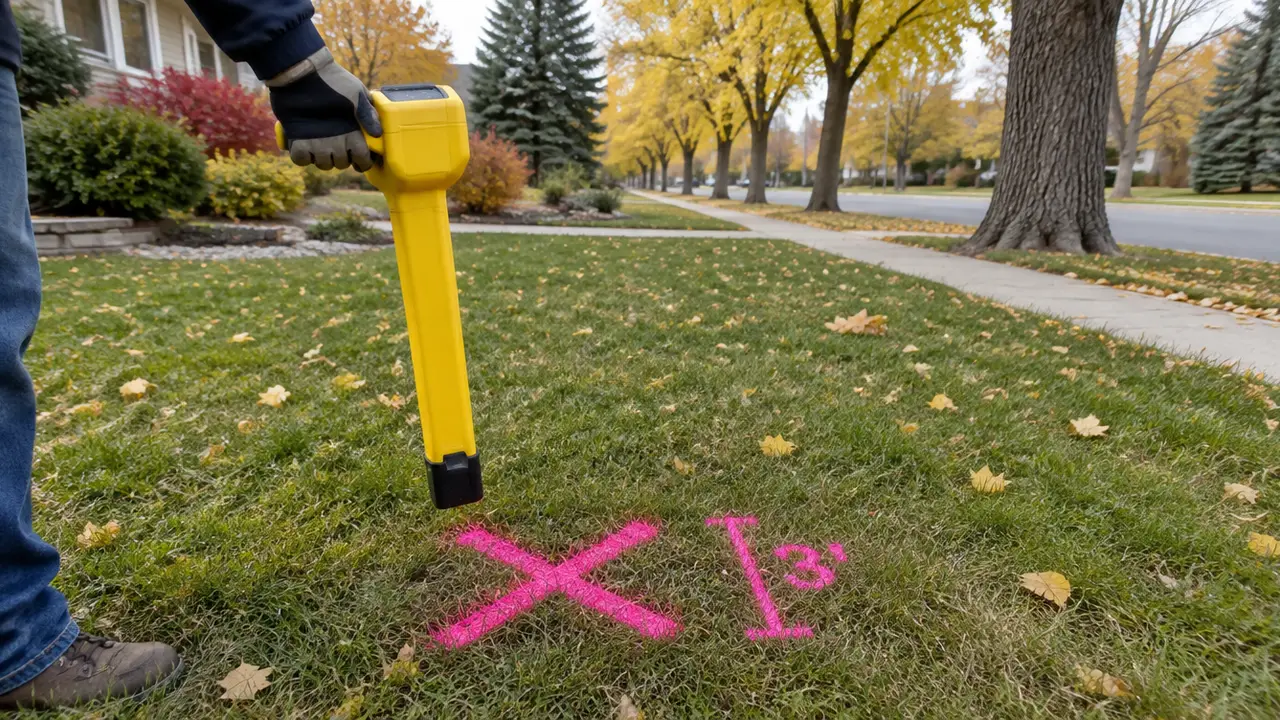
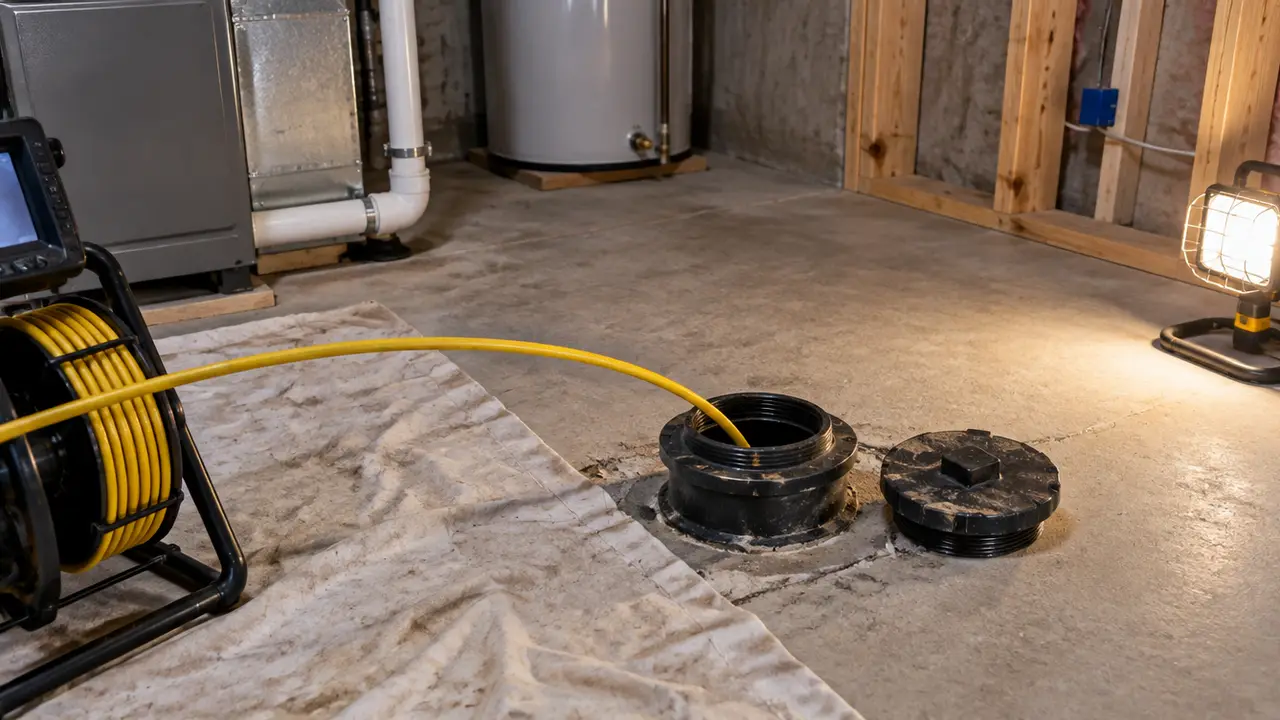
Whenever anyone is about to dig, and whenever the route matters for a decision such as a deck, fence posts, a garage or a replacement scope. The clues above narrow the search; a sonde trace gives a marked line and depth estimates that a crew can plan around. The method, a small transmitter pushed on the camera cable and followed from the surface, is described step by step in utility locates for a Calgary sewer dig.
Utility Safety Partners' homeowner page is explicit that customer-owned lines, including water and sewer service lines, are not registered with it, so the free public locate will never mark your lateral. The trace is a private service, usually booked with a sewer camera inspection or included in a replacement contractor's pre-dig visit. National pricing for camera visits is covered at SewerQuotes.com, and this site's cost drivers page explains where a trace sits in a replacement budget.
- Ask for marks every few metres, and at each change in direction, not just at the two ends.
- Ask for a depth reading at each mark and write it on your sketch with the footage-counter distance.
- Ask what stopped the camera if it could not reach the property line; the unmarked part of the route is still unknown.
- Keep the recording. The same file supports the scope, the permit and any later claim.
06 /How deep are utility lines buried in Calgary?
There is no single answer, and the safest habit is never to assume one. Utility Safety Partners states that locate markings identify the approximate location of buried utilities and do not identify the depth of the line. Depths also drift over time as yards are regraded, patios built up or soil cut away for a walkout.
| Line | What the City or locator tells you | What that means for tracing |
|---|---|---|
| New sanitary service (your sewer) | The City's infill guidance sets frost-protection cover of 4.5 ft for sanitary services | A minimum for new work; a basement home's lateral leaves under the slab and is usually much deeper |
| New water service | The same guidance sets 8.5 ft of cover for water services | Water can sit deeper than a shallow sewer, so do not assume the sewer is the bottom line |
| Gas, power, telecom | Marked for position only through Utility Safety Partners | Depth unknown until exposed by hand or hydrovac within one metre of the marks |
| Your older lateral | A sonde estimate from the surface | Treat as approximate; metal nearby and steep drops affect readings |
Why basement-home laterals sit so deep, and how Calgary's clay, till and cobble behave in a trench, is covered on the Calgary soils and depth page.
07 /How should you record the route once you find it?
Paint marks fade in a few weeks and flags get mowed. Turn the route into a sketch the same day, measured from things that will not move, and file it with the footage.
- Draw the house footprint and the property lines, and mark the exit wall and the City connection point.
- Measure each sonde mark from two fixed corners of the house, so any mark can be re-found later.
- Write depth readings and footage-counter distances beside each mark.
- Add every other private line the locator found, such as garage feeds, irrigation and gas to a barbecue.
- Photograph the painted yard from two corners before the marks fade.
That sketch becomes the base of a written scope; setting the scope shows how. When the route is on paper, the Permit & Locate Checklist picks up from there, and you can request quotes with the sketch attached so every contractor prices the same line.
FAQQuestions people ask
How can I find my sewer line in Calgary without digging?
Start with the inside cleanout and the wall the building drain heads toward, then look up the City's record for your address to see where its section meets your property line. A camera with a sonde then marks the route and estimates depth from the surface.
Does the City of Calgary have a map showing my sewer line?
Only part of it. The Public Sanitary Service Lines open data maps the City-owned section from the main to your property line. The private run across your lot is not mapped by the City.
Can a metal detector find a sewer pipe in the yard?
Rarely. Clay, PVC and lined pipes are non-metallic, and a detector picks up every nail and rebar piece near the surface. A sonde inside the pipe is the reliable way to trace a lateral.
Why is the City's recorded pipe length so short?
Because it covers only the public section between the main and your property line. For single-family homes that piece averaged about 8 metres in the City's data in September 2026; the rest of the line is on your lot.
Who has to locate the old service on a lot that is being redeveloped?
The City's demolition permit guide says the lot owner or engineer of record is responsible for locating the existing service and recording the last known location of the service valves.
Does the sewer always leave from the front of the house?
No. It leaves on the side facing the City's main, which is often the street but in some communities is the back lane. The mapped City record shows which side your connection is on.
NETWORKGo deeper across the HAUSE Sewer network
Sewer line locating and depth: how the mark on your lawn is made
How sewer line locating and depth readings work: the sonde, the hand-held locator, peak and null readings, marking, accuracy, and calling before you dig.
SewerRoots.caPlanting Distance Checker
Planting Distance Checker: pick a tree, shrub or perennial group, enter its distance from the sewer lateral, and see if the spot meets the guideline.
SewerCleaners.caWhere is my backwater valve? How to find it, recognize it and open the cover
Where is the backwater valve in a house? How to find it, what it looks like, what access box, sleeve and cover mean, how to open it safely, and valve alarms.